Benchmarks for contractors: what good looks like for answer rate, booking rate, and speed
Updated
Most renovation contractors have no idea whether their sales numbers are good or not. They know their close rate and roughly how many estimates they send per month, but they have no external reference point for what those numbers should be. This post establishes concrete benchmarks for the five metrics that most directly determine how much revenue a renovation contractor captures from their existing lead flow: answer rate, response speed, booking rate, close rate, and follow-up depth. Use these to diagnose where you are losing jobs.
Key takeaways
- The industry average answer rate for renovation contractors is 45% to 60% — meaning roughly half of all inbound inquiries receive no meaningful response.
- Responding within 5 minutes versus 30 minutes produces a 21x higher contact rate — industry surveys suggest the average contractor responds in roughly 42 minutes.
- The difference between a 22% and 35% close rate at 20 estimates per month is approximately $156,000 in additional monthly revenue — and it usually comes from follow-up, not pricing.
- Most contractors provide 1-2 follow-up touches; the research says homeowners need 6-8 before making a high-ticket renovation decision.
- Start diagnosing from the top of the funnel — fix answer rate and speed before optimizing close rate.
Why do contractor sales benchmarks matter for revenue?
Contractor sales benchmarks are industry-standard reference points for the key metrics — answer rate, response speed, booking rate, close rate, and follow-up depth — that determine how much revenue a renovation business captures from its existing lead flow.
There is a specific kind of revenue loss that does not show up in any financial report. It is the job you did not win because someone else responded first. The estimate that went cold because you did not follow up at day 14. The lead that called at 8 PM and reached voicemail and not called back.
These losses are invisible unless you are measuring the right things. And you cannot know whether your numbers are a problem until you know what the numbers should look like.
The benchmarks below are based on published industry research, home services sales data, and recurring patterns across renovation contractor businesses in the $500K to $3M revenue range. They are not aspirational targets pulled from marketing copy — they are descriptive ranges based on actual performance patterns.
What is a good answer rate for renovation contractors?
Answer rate measures the percentage of inbound inquiries — calls, web forms, texts, and messages — that receive a response from your business within 24 hours. Any inquiry left unanswered beyond that window is, for practical purposes, a lost lead.
| Rating | Answer rate | What it typically means |
|---|---|---|
| Poor | Below 40% | No system for catching after-hours or on-site missed inquiries; significant lead bleed |
| Average | 40% to 70% | Handles business-hours inquiries adequately; loses a meaningful share after hours and on weekends |
| Good | 70% to 85% | Has some after-hours coverage; still some gaps |
| Excellent | 85%+ | Automated or staffed with compliant after-hours coverage; materially lower lead loss from non-response |
Source: BrightLocal Local Consumer Review Survey; Invoca Call Intelligence Report 2024; home services industry benchmarks.
The industry average for renovation contractors is somewhere in the 45% to 60% range — meaning roughly half of all inbound inquiries receive no response, or a response so delayed that the homeowner has moved on. The primary driver of poor answer rates is not bad intentions — it is the structural reality of being an active contractor. You cannot answer your phone while operating a saw or running a crew meeting.
The fix is not answering more calls. It is having a system that answers when you cannot. If your after-hours coverage is the weak point, the after-hours lead capture guide covers the specific systems that close that gap.
How fast should contractors respond to new leads?
Speed-to-lead measures how quickly your business makes first contact with a new inquiry. This is one of the most studied metrics in sales research, and the findings are consistent: the first business to have a substantive conversation with a prospective customer wins a disproportionate share of deals.
| Rating | Response time | Competitive impact |
|---|---|---|
| Poor | More than 4 hours | Homeowner has likely already engaged with a competitor; contact probability drops sharply |
| Average | 1 to 4 hours | May still connect, but another contractor likely already has a conversation started |
| Good | 5 to 60 minutes | Competitive — most contractors respond slower; strong chance of being first contact |
| Excellent | Under 5 minutes | First to respond in virtually every scenario; sets the frame for all subsequent comparison |
Source: Harvard Business Review “The Short Life of Online Sales Leads” (James Oldroyd et al.); InsideSales.com Lead Response Management study; industry response time benchmarks for home services contractors.
Industry surveys suggest the average response time for renovation contractors is roughly 42 minutes. That sounds reasonable until you consider that homeowners researching renovation projects typically contact three to five contractors in a single session. If four of those five respond within 30 to 60 minutes, but you respond four hours later — you are last. Being last is not a tie. In competitive markets, the contractor who initiates a real conversation first has a meaningful structural advantage. For a deeper look at why that 42-minute number is so damaging, see the 42-minute problem analysis.
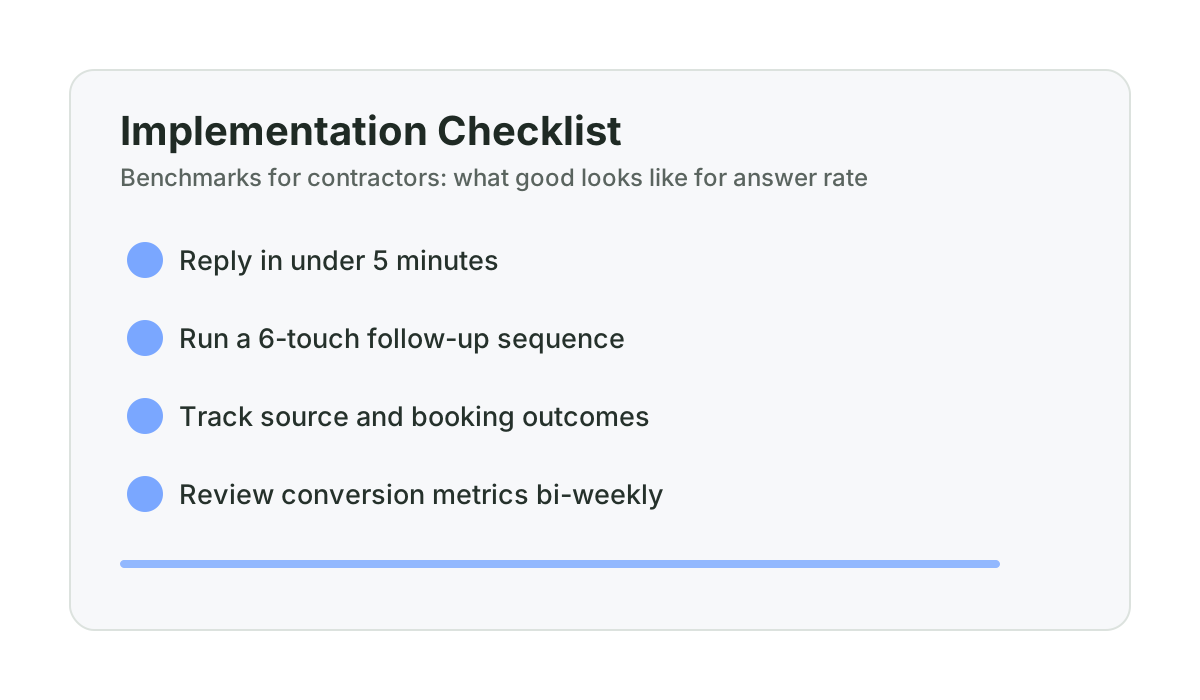
The research on contact rate decay is stark: contacting a lead within 5 minutes versus 30 minutes results in a 21x higher contact rate. After the first hour, the odds of making meaningful contact drop by roughly 60%. After 24 hours, you are reaching a very small fraction of the people who originally inquired. Source: InsideSales.com; Drift Conversational Marketing research.
See what the numbers look like when follow-up actually happens
Download a sample results dashboard showing the metrics that matter: response time, booking rate, close rate, revenue recovered.
Run the numbers for your business: See the Results Dashboard. It takes 2-3 minutes and gives you a clear baseline before your next estimate round.
Benchmark 3: Booking rate
Booking rate measures what percentage of qualified inquiries convert to a scheduled estimate appointment. This is distinct from close rate — it measures the conversion from interested homeowner to estimate on the calendar, not from estimate to signed contract.
| Rating | Booking rate | What it indicates |
|---|---|---|
| Poor | Below 15% | Losing most qualified leads before the estimate stage; often a speed or qualification problem |
| Average | 15% to 25% | Capturing a moderate share; losing some to slow response, phone tag, or no follow-up |
| Good | 25% to 35% | Solid intake and qualifying process; minimal leakage between inquiry and estimate |
| Excellent | 35%+ | Near-optimal conversion from inquiry to estimate; fast response and smooth intake experience |
Source: ServiceTitan contractor benchmarks; home services industry benchmarks.
Booking rate is where slow response time and after-hours lead loss show up in the numbers. If your answer rate is 60% and your response time is four hours, your booking rate will reflect those gaps — because the homeowners you are not capturing are disproportionately the ones who inquired after hours or when you were unavailable.
A contractor with a 70% answer rate, sub-5-minute response time, and a conversational AI that qualifies and books appointments will consistently book a higher percentage of inquiries than one who relies on manual follow-up and next-day callbacks. The booking rate is a downstream expression of your answer rate and response speed.
What close rate should renovation contractors target?
Close rate measures what percentage of sent estimates convert to signed contracts. For renovation contractors, this is heavily influenced by how consistently you follow up after the estimate — not just by the quality of the estimate itself.
| Rating | Close rate | Typical driver |
|---|---|---|
| Poor | Below 20% | Minimal or no follow-up; estimates go cold; often attributed to price shoppers but driven by process gaps |
| Average | 20% to 30% | One or two follow-up touches; some homeowners convert, many fall off after a single email |
| Good | 30% to 40% | Structured multi-touch follow-up; catches homeowners who needed more time or more contact |
| Excellent | 40%+ | Consistent 6 to 8 touch sequence over 6+ weeks; long-cycle nurture for delayed decisions |
Source: Remodeling Magazine “Cost vs. Value” industry data; home services industry benchmarks.
A common mistake contractors make when diagnosing close rate is assuming it reflects estimate quality. It often does not. A 22% close rate and a 35% close rate can represent the exact same contractor doing the exact same quality of work — the only difference is whether there is a structured follow-up sequence running after the estimate goes out.
Industry research consistently shows that contractors who implement structured multi-touch follow-up sequences see measurable close rate improvements — often moving from the 20% to 25% range into the 30% to 40% range — with no change to pricing, no change to estimating approach, and no additional lead generation spend. The improvement comes entirely from ensuring homeowners receive six to eight touches at appropriate intervals instead of one check-in email.
At 20 estimates per month with an average project value of $60,000, the difference between a 22% and a 35% close rate is approximately 2.6 additional projects per month — about $156,000 in monthly revenue, or $1.87 million annually. That is not a marketing budget change. That is a follow-up process change.
How many follow-up touches do contractors actually need?
Follow-up depth is the number of structured contact attempts made after sending an estimate before marking the lead as inactive — and it is the metric with the clearest gap between what contractors do and what the research recommends.
| Rating | Follow-up touches | Typical outcome |
|---|---|---|
| Poor | 1 to 2 touches | Catches only homeowners already decided; loses most considering leads |
| Average | 3 to 4 touches | Better than most competitors; still misses late-deciders who need more time |
| Good | 5 to 6 touches | Covers the standard 2-to-6-week decision window for most renovation projects |
| Excellent | 7+ touches (with long-cycle nurture) | Captures homeowners on delayed timelines; catches projects that restart after 2 to 6 months |
Source: Industry lead nurture research; InsideSales.com “Lead Follow-Up Benchmarks.”
The data on follow-up depth is consistent and has been consistent for years: it takes an average of six to eight touchpoints for a homeowner to make a high-ticket renovation decision. Most renovation contractors provide one to two. The practical implication: contractors are dropping out of the sales process three to five touches before homeowners are ready to decide.
This is not just about persistence. It is about timing. Renovation decisions get delayed — not cancelled. A homeowner who went quiet in September may re-engage in January when their financing came through, their busy season at work ended, or they finally cleared space in their schedule. The contractor who maintained regular, non-pushy contact throughout that period is the one who gets the call when they are ready. The contractor who sent one follow-up email in September is not top-of-mind in January.
How to use these benchmarks to find your highest-value improvement area
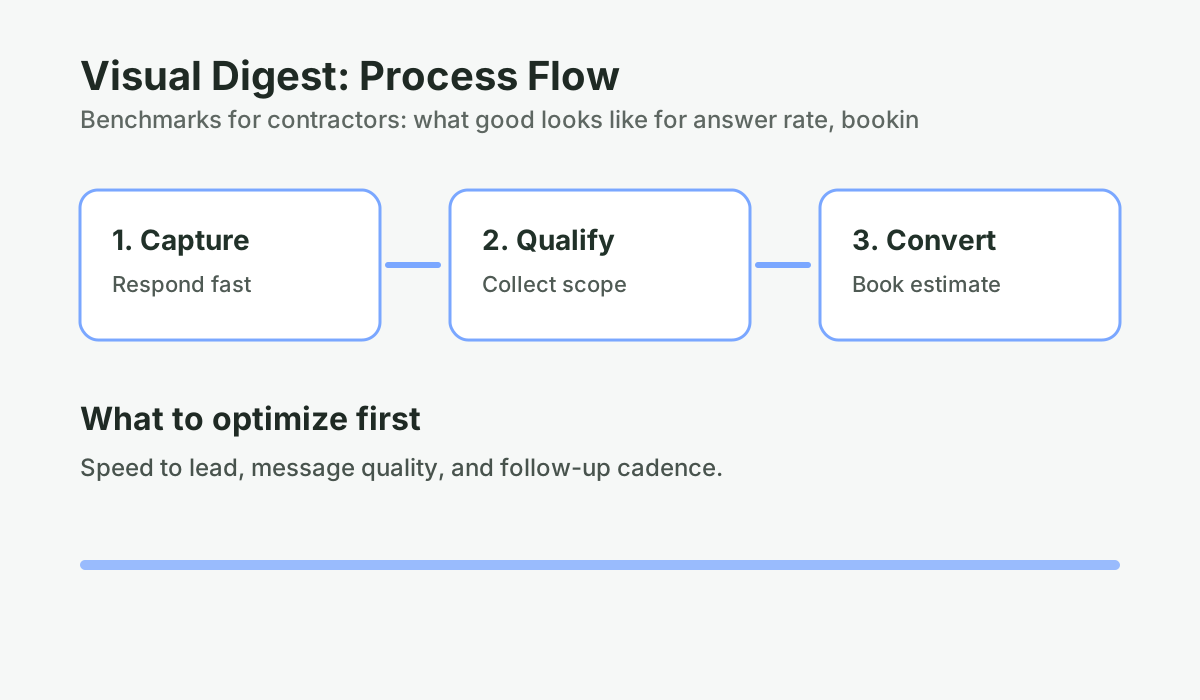
These five metrics form a funnel. Problems at the top of the funnel (answer rate, response speed) suppress everything downstream. There is no point optimizing your close rate if you are losing 40% of inquiries before they ever get to the estimate stage.
A practical diagnostic sequence:
- Start with answer rate. Are you capturing all inbound inquiries, including after-hours and weekend ones? If not, that is the first leak to fix.
- Check response speed. How quickly is your first contact happening? If you are regularly over an hour, you are losing competitive position in nearly every scenario. The speed-to-lead SOP for renovation contractors provides a step-by-step implementation guide.
- Assess booking rate. Of the leads you are capturing, what percentage becomes an estimate? If this is low, the intake conversation itself may need work — or speed and coverage are the culprit.
- Evaluate close rate. If your booking rate is solid but close rate is below 30%, the follow-up process is almost certainly the issue.
- Count your follow-up touches. Be honest. How many structured contacts do you actually send after an estimate? Most contractors, when they count honestly, are at one to two.
| Metric | Poor | Average | Good | Excellent |
|---|---|---|---|---|
| Answer rate | Below 40% | 40% to 70% | 70% to 85% | 85%+ |
| Response time | More than 4 hours | 1 to 4 hours | 5 to 60 minutes | Under 5 minutes |
| Booking rate | Below 15% | 15% to 25% | 25% to 35% | 35%+ |
| Close rate | Below 20% | 20% to 30% | 30% to 40% | 40%+ |
| Follow-up touches | 1 to 2 | 3 to 4 | 5 to 6 | 7+ with nurture |
Most renovation contractors who go through this exercise find they are average or poor on at least two of these five metrics. That is not a character indictment — it is a structural finding. The same business, with the same quality of work, the same prices, and the same lead volume, can produce dramatically different revenue depending on where these metrics sit.
One recovered project — one $45,000 basement, one $75,000 kitchen — typically covers the cost of a managed revenue recovery system for two to four years. That is not a pitch. That is the arithmetic of what these metrics are worth when they move from average to good.
Frequently asked questions
What is a good answer rate for a renovation contractor?
A good answer rate for a renovation contractor is 70% to 85% — meaning at least 70% of all inbound inquiries receive a response within a reasonable time window. Excellent is 85% or higher, which generally requires automated coverage for after-hours and weekend inquiries. The industry average sits around 45% to 60%, meaning the majority of contractors are losing a significant share of their inbound leads to non-response.
What is the industry average response time for renovation contractors?
Industry response time benchmarks suggest the average first-response time for renovation and home services contractors is approximately 42 minutes. This is well outside the window where contact rates are highest — research consistently shows that responding within 5 minutes produces significantly higher contact and conversion rates compared to responding an hour or more later.
What close rate should a renovation contractor expect?
The average close rate for renovation contractors is 20% to 30%. Contractors with structured multi-touch follow-up sequences routinely achieve 30% to 40%. Reaching 40%+ typically requires both strong follow-up depth (7+ touches over 6+ weeks) and a qualifying process that filters out poor-fit leads before the estimate stage. If your close rate is below 25%, structured automated follow-up is often the highest-leverage improvement available.
How many times should a contractor follow up on an estimate before giving up?
The research on high-ticket home services purchasing suggests six to eight touches before a homeowner makes a decision. Practically, this means a structured sequence of five to six contacts over the first six weeks after an estimate, followed by monthly long-cycle nurture for those who have not formally declined. Most contractors do one to two follow-ups. The gap between one or two and six to eight is where a substantial portion of close rate improvement lives.
Which of these five metrics should a contractor improve first?
Start with answer rate and response speed — they are top-of-funnel and suppress everything downstream. If you are losing 40% of inquiries before they ever reach the estimate stage, improving your close rate will not compensate. Once you are capturing most inquiries and responding quickly, move to booking rate and follow-up depth. Close rate improvements typically follow naturally from improving follow-up depth — which is the single metric most contractors can improve the most, in the least time, with the clearest ROI.
Want help applying this to your pipeline?
Use the matching diagnostic tool first, then book a quick strategy call if you want a done-for-you rollout.

Mashrur Rahman
Founder, ConversionSurgery
I build revenue recovery systems for renovation contractors. After seeing how much money remodelers lose to slow follow-up and missed calls, I built a managed service that handles lead response, estimate follow-up, and after-hours capture automatically. The data in these articles comes from running these systems across real contracting businesses.
Related reading
Alberta contractor lead report template: the “without us” line that improves retention
A practical reporting template that makes ongoing system value visible to contractor owners every two weeks.
Calgary vs Edmonton renovation conversion benchmarks: answer rate, speed, and close-rate realities
A practical city comparison to help Alberta contractors set realistic speed and conversion targets by market conditions.
How renovation contractors use Google reviews to win more estimates in Alberta
A review engine for Alberta remodelers: request timing, response templates, and GBP visibility impact on estimate bookings.