The after-hours renovation lead problem: what a 9:47 PM inquiry reveals about contractor revenue loss
Updated
The most expensive leads a renovation contractor loses are not the ones that do not arrive. They are the ones that arrive when no one is there to respond. Industry surveys suggest that up to 40% of all inbound renovation inquiries come in after business hours, and 85% of people who reach voicemail do not call back. Those two numbers, taken together, describe a structural revenue leak that most contractors do not quantify — because the lost jobs do not show up in any report.
This analysis uses published industry data to model a specific scenario: a homeowner submits a renovation inquiry at 9:47 PM on a Saturday. It walks through what the research says will happen under two conditions — an automated response at the next permitted window versus the typical delayed manual response — and what that difference means in actual revenue.
No fictional clients. No made-up numbers. Just the data, the math, and the implications.
Key takeaways
- Up to 40% of renovation inquiries arrive outside business hours, primarily between 7 PM and 11 PM on weekdays and throughout Saturday afternoons and evenings. Source: Industry call tracking data; Thumbtack Pro industry benchmarks.
- 85% of callers who reach voicemail do not call back — making after-hours lead capture a critical and often invisible revenue lever. Source: Invoca and CallRail call analytics benchmarks.
- The first contractor to have a substantive conversation wins 35% to 50% of home service deals, regardless of pricing or quality differences. Source: Harvard Business Review, “The Short Life of Online Sales Leads.”
- Responding within five minutes instead of 30 produces a 21x higher contact rate. Industry response time benchmarks suggest an average contractor response time of 42 minutes — and weekend inquiries often wait 36 or more hours. Source: InsideSales.com lead response research; industry response time benchmarks.
- For a contractor averaging $65,000 per project and receiving 30 inquiries per month, unrecovered after-hours leads represent an estimated $66,300 to $116,025 in lost annual revenue.
What is an after-hours renovation lead?
An after-hours renovation lead is any homeowner inquiry — call, form submission, text, or message — that arrives outside standard business hours, typically between 5 PM and 8 AM on weekdays or anytime on weekends and holidays. For renovation contractors, these leads are disproportionately high-intent because they come from homeowners who have been thinking about a project for weeks or months and finally have time to act.
The timing pattern is not random. Renovation is a considered purchase. Homeowners do not decide to remodel a kitchen on a whim during lunch. They research, discuss with their partner, browse portfolios, and eventually sit down — usually after dinner, after the kids are in bed, when they finally have uninterrupted time — to start reaching out to contractors.
Thumbtack Pro’s industry benchmarks show a consistent inquiry spike between 7 PM and 11 PM on weekdays and throughout Saturday afternoons and evenings. Source: Thumbtack Pro, contractor inquiry timing data. Industry call tracking data suggests the after-hours share may reach up to 40% of total inbound volume for home service businesses. Source: Industry call tracking data.
That means a significant share of the pipeline for a typical renovation contractor arrives when the office is closed, the phone goes to voicemail, and the inquiry form sits unread until Monday morning.
Why do homeowners inquire at 9:47 PM on a Saturday?
The scenario is specific because the pattern is specific. A homeowner couple who has been discussing a whole-home renovation for months finally sits down on a Saturday evening with a laptop. The kids are asleep. There is time to focus. They open four or five contractor websites and start filling out inquiry forms.
This is not casual browsing. This is purchasing behavior. Research from Google’s consumer journey studies shows that homeowners considering renovations over $50,000 typically spend two to four weeks in active research before making first contact — and when they do reach out, they contact three to five contractors in a single session. Source: Google/Ipsos, “Understanding the Home Services Consumer Journey.”
The 9:47 PM Saturday inquiry is not an outlier. It is the norm. And what happens when the next permitted response window opens often determines which contractor wins the job.
What does the research say about response time and conversion?
Speed-to-lead is the elapsed time between when a prospect submits an inquiry and when a business makes first substantive contact. In home services, it is the single strongest predictor of which contractor books the estimate and wins the job.
The data on this is unusually consistent across multiple studies and time periods:
| Finding | Source | Year |
|---|---|---|
| Responding within 5 minutes vs. 30 minutes produces a 21x higher contact rate | InsideSales.com lead response research | 2011 (revalidated 2021) |
| First to respond wins 35% to 50% of deals in home services | Harvard Business Review, “The Short Life of Online Sales Leads” | 2011 |
| Industry average contractor response time: 42 minutes | Industry response time benchmarks | 2023 |
| 85% of voicemail callers do not call back | Invoca / CallRail call analytics benchmarks | 2023-2024 |
| Up to 40% of home service inquiries arrive after business hours | Industry call tracking data | 2023 |
| Inquiry volume peaks 7-11 PM weekdays, Saturday afternoons and evenings | Thumbtack Pro, contractor inquiry timing | 2022-2023 |
The 42-minute industry average is for daytime inquiries when contractors are at least theoretically reachable. For an inquiry that arrives at 9:47 PM on a Saturday, the realistic response time for most contractors is not 42 minutes — it is 36 to 60 hours. The form sits unread until Monday morning, or in some cases until Tuesday if Monday is busy on the job site. For a deeper analysis of what that 42-minute average actually costs, see the 42-minute problem: how renovation leads go cold.
What happens when a contractor captures a 9:47 PM inquiry and responds at the next permitted window?
The model below applies published research to two scenarios for that Saturday night inquiry.
Scenario A: Automated response at 10:00 AM Sunday (next permitted window). The homeowner is still sitting at the kitchen table with the laptop open. They get a text message that references their specific project, asks a qualifying question about scope, and starts an intelligent conversation. The system — an AI conversation agent trained on the contractor’s business — qualifies the lead, answers the homeowner’s initial questions about process and timeline, and offers available estimate times for the following Monday morning.
From the homeowner’s perspective, this contractor is responsive, organized, and already moving toward a next step. The conversation starts Sunday morning and takes 15 to 30 minutes. An estimate is booked. By the time the homeowner fills out the fourth contractor’s form, one contractor already has a Monday appointment locked in.
Scenario B: No response until Monday or Tuesday. The homeowner fills out the form and gets either no confirmation or a generic auto-reply (“Thanks for your inquiry. We will get back to you within 24-48 business hours.”). They move on to the next contractor on their list. By Monday morning, one of the four or five contractors they contacted has probably already responded — and that contractor has shaped the homeowner’s frame of reference for evaluating everyone else.
The research predicts the outcome clearly: the contractor who responds first wins 35% to 50% of the time. Source: Harvard Business Review, “The Short Life of Online Sales Leads.” Not because they apply closing pressure, but because they establish presence and trust before the competition arrives.
| Factor | Automated response at next permitted window (seconds after window opens) | Typical delayed response (36+ hours) |
|---|---|---|
| First response time | 10:00 AM Sunday (seconds after permitted window opens) | Monday morning at earliest (36+ hours) |
| Homeowner engagement level | High — still in active research mode | Low — already spoke with faster responders |
| Estimate booked? | Yes — during the Sunday morning conversation | Maybe — if the homeowner has not already committed elsewhere |
| Competitive position | First conversation sets the frame of reference | Evaluated against the contractor the homeowner already likes |
| Probability of winning the job (based on first-responder research) | 35% to 50% | Significantly lower — competing as a late entrant |
See what the numbers look like when follow-up actually happens
Download a sample results dashboard showing the metrics that matter: response time, booking rate, close rate, revenue recovered.
Run the numbers for your business: See the Results Dashboard. It takes 2-3 minutes and gives you a clear baseline before your next estimate round.
How much revenue are contractors losing to after-hours lead leakage?
Here is the math, using conservative published numbers. The model below uses the lower end of each range.
Take a renovation contractor who receives 30 inquiries per month with an average project value of $65,000. These are not unusual numbers for an established remodeler in the $800K to $1.5M annual revenue range.
| Variable | Value | Source |
|---|---|---|
| Monthly inquiries | 30 | Typical for $800K-$1.5M contractor |
| After-hours share | Up to 40% (12 leads) | Industry call tracking data |
| Lost to voicemail/no-response | 85% of after-hours (approximately 10 leads) | Forbes Advisor citing CallRail |
| Average project value | $65,000 | ICP average (kitchen, basement, bathroom) |
| Close rate on responded leads | 25% | Industry average for renovation |
| Monthly lost revenue potential | 10.2 leads x 25% close rate x $65,000 = $165,750 | Calculated |
| Recoverable portion (conservative) | 40% to 70% with automated response at the next permitted window | Based on first-responder advantage research |
| Annual recoverable revenue (conservative) | $66,300 to $116,025 | Calculated: ($165,750 x 40-70% recovery) |
Those numbers are conservative. They use a 25% close rate (the industry average, not the higher rates that faster-responding contractors tend to achieve) and they assume only partial recovery of the lost leads. The actual number for many contractors is higher.
The point is not precision — it is magnitude. This is not a $5,000-a-year problem. For most established renovation contractors, after-hours lead leakage represents six figures in annual revenue that does not get captured, does not get tracked, and does not show up in any report. To run the specific calculation for your business, the revenue leak calculator walks through it step by step.
Why does first-responder advantage compound at night?
The first-responder effect — the 35% to 50% win rate for the contractor who responds first — is well established during business hours. But the effect is even stronger for after-hours inquiries, for two structural reasons.
First: the comparison set collapses. During business hours, a homeowner who contacts four contractors might get two or three responses within the first hour. The first-responder advantage exists but is moderated by competition. At 9:47 PM on a Saturday, the homeowner likely gets zero responses from three of the four contractors and one queued response sent at the next permitted window from the contractor with an automated system. There is no comparison set. The first responder is the only responder.
Second: the homeowner is in peak decision-making mode. They are not casually browsing. They have carved out time for this. They are ready to engage. A prompt response when the next permitted window opens catches them at high receptivity. A Monday morning response catches them back at work, distracted, and potentially already feeling good about the contractor who responded first at the next permitted window.
This is why after-hours response capability is not just incrementally better than daytime response — it is categorically different. The competition is asleep. The homeowner is awake and ready. A contractor with an automated system is functionally the only option available in that moment. For a deeper look at why speed-to-lead functions as a leading indicator of revenue, see the speed-to-lead KPI analysis.
What does an effective after-hours response look like?
There is an important distinction between an auto-reply and a substantive response. A generic auto-reply (“Thanks for your inquiry. Someone will get back to you during business hours.”) does not produce the first-responder advantage. It acknowledges receipt. It does not start a conversation.
The research on first-responder advantage specifically measures substantive contact — a real conversation that engages the prospect, qualifies their needs, and moves toward a next step. Source: Harvard Business Review, “The Short Life of Online Sales Leads.”
An effective after-hours response system needs to do four things:
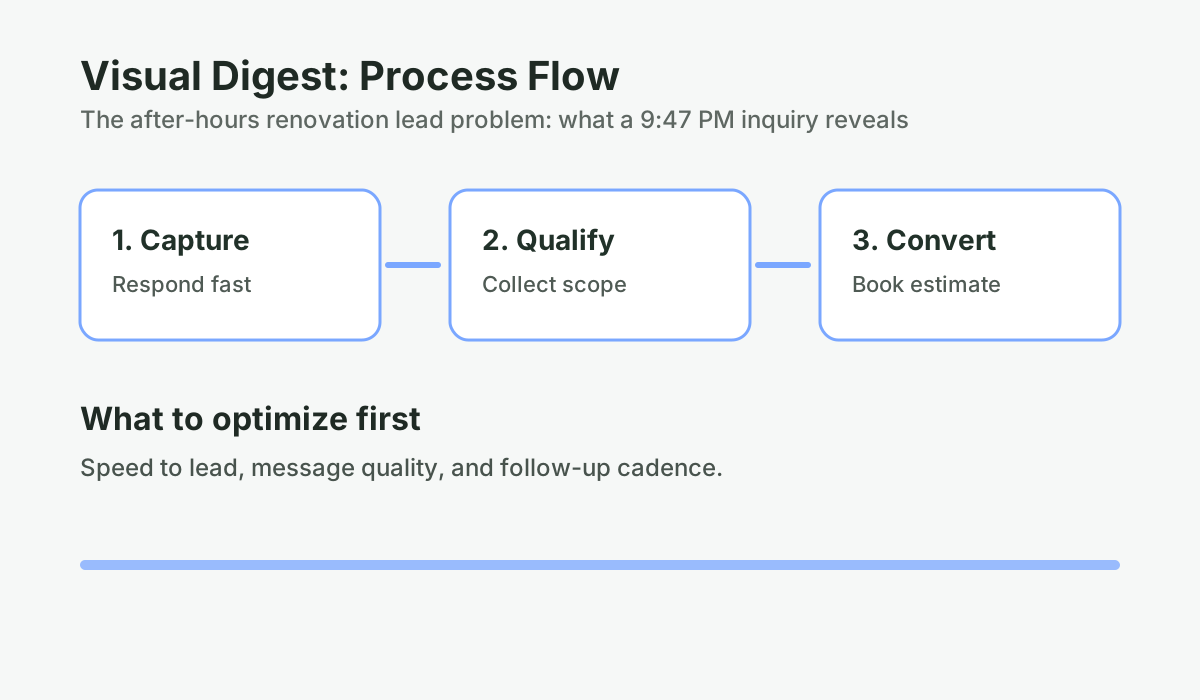
- Respond as soon as permitted. The 21x contact rate advantage at five minutes versus 30 minutes means every second counts once messaging is allowed. An automated system can queue after-hours inquiries and respond within seconds when the next permitted window opens. A human checking their phone before bed usually responds much later — if at all.
- Reference the specific project. “Thanks for reaching out about your kitchen renovation” is fundamentally different from “Thanks for your inquiry.” It signals that someone (or something) actually read the submission.
- Ask qualifying questions. Scope, timeline, budget range, decision criteria. This serves two purposes: it gathers information the contractor needs, and it keeps the homeowner engaged in a conversation rather than moving to the next form.
- Book a concrete next step. The goal of the after-hours conversation is not to close the deal — it is to get an estimate appointment on the calendar before the homeowner talks to a competitor. If the conversation ends with “someone will call you Monday,” it has not accomplished much more than the auto-reply.
This is the functional gap that AI conversation agents fill. Not as a replacement for the contractor’s expertise — but as a system that captures the 9:47 PM Saturday inquiry and starts the conversation in the next permitted window, so the contractor does not have to sacrifice evenings and weekends to capture high-value leads. For a complete breakdown of how after-hours capture systems work, see the after-hours lead capture guide for contractors.
What is the real cost of not having after-hours response?
The cost is not just the lost leads. It is the compounding effect of those losses over time.
Consider a contractor who loses 8 to 10 after-hours leads per month. That is 96 to 120 leads per year. At a 25% close rate and $65,000 average project value, that is a theoretical maximum of 24 to 30 projects — roughly $1.56 million to $1.95 million in project value — passing through their pipeline and disappearing without a trace.
No system captures 100% of those. But the difference between capturing 0% (which is what happens with voicemail after hours) and capturing 40% to 60% (which is what the response-time research suggests is achievable with fast engagement) is the difference between leaving seven figures on the table and recovering a meaningful portion of it.
The other cost is harder to quantify but equally real: every after-hours lead that goes to a competitor is a job that competitor completes, a review they earn, a referral they receive, and a portfolio piece they add to their website. The revenue leak does not just cost the immediate project — it strengthens the competition.
What should contractors do with this data?
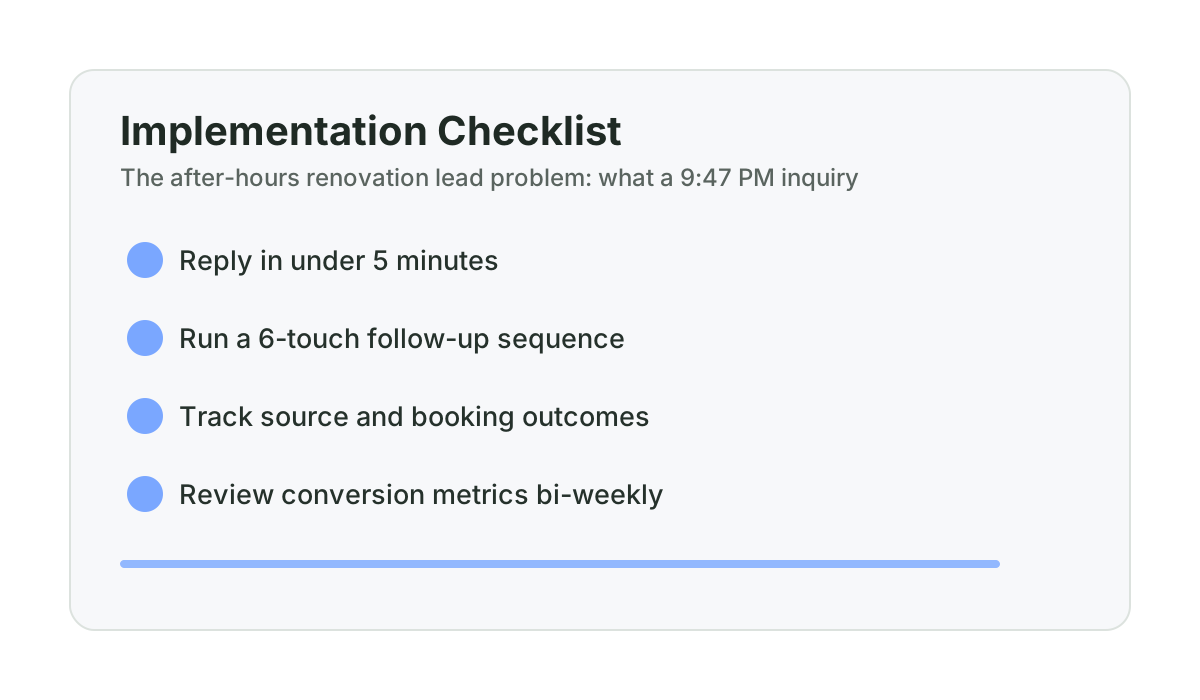
The first step is measurement. Most contractors have no idea what percentage of their inquiries arrive after hours, or what happens to those leads. Before investing in any solution, track two things for 30 days:
- When do your inquiries arrive? Check the timestamps on your form submissions, missed calls, and voicemails. If the published data holds for your business, a significant share — potentially up to 40% — will be after hours.
- What is your actual response time for after-hours leads? Not your intended response time — your actual measured time from inquiry to first substantive contact. For most contractors, this number is measured in days, not minutes.
If those two numbers confirm the pattern — a large share of after-hours volume and multi-hour or multi-day response times — the revenue impact model above applies directly to your business. The specific dollar amount depends on your inquiry volume and average project value, but the structural problem is the same.
The solution is some form of automated after-hours response that can have a real conversation, not just acknowledge receipt. Whether that is an AI conversation agent, a virtual receptionist service with after-hours coverage, or some other system — the key requirement is substantive engagement as soon as the next permitted window opens, not days later.
ConversionSurgery runs this as a managed service for renovation contractors. But whether you use our system or build your own, the data points in the same direction: after-hours lead capture is not a nice-to-have. For contractors doing $500K or more in annual revenue, it is one of the highest-leverage operational fixes available.
Frequently asked questions
What percentage of renovation inquiries come in after business hours?
Industry call tracking data suggests that up to 40% of inbound inquiries for home service businesses arrive outside standard business hours. Thumbtack Pro data further narrows the peak to 7 PM through 11 PM on weekdays and throughout Saturday afternoons and evenings — times when homeowners have finished work and can focus on renovation research and outreach.
What happens when a contractor does not respond to an after-hours renovation lead?
Call analytics data from Invoca and CallRail shows that approximately 85% of callers who reach voicemail do not call back. For form submissions, the dynamic is similar — if no substantive response arrives while the homeowner is still in active research mode, they move on to the next contractor. The combination of significant after-hours volume and 85% abandonment means that a contractor without after-hours response capability is structurally losing a significant portion of their inbound pipeline without ever knowing it.
How much faster does a contractor need to respond to win more jobs?
InsideSales.com research shows that responding within five minutes versus 30 minutes produces a 21x higher contact rate. Industry response time benchmarks suggest an average contractor response time of 42 minutes during business hours. For after-hours inquiries, the typical response gap is measured in days, not minutes — which means the improvement potential is even larger than the daytime research suggests.
Does the first contractor to respond really win more often?
Yes. Harvard Business Review’s lead response study found that the first vendor to make substantive contact wins 35% to 50% of deals. In renovation contracting, where homeowners typically contact three to five contractors in a single research session, being first means setting the frame of reference against which every other contractor is evaluated. This effect is amplified for after-hours inquiries, where most competitors do not respond at all until the next business day.
Is an auto-reply the same as a substantive response?
No. The first-responder research specifically measures substantive contact — a real interaction that engages the prospect, qualifies needs, and moves toward a next step. A generic auto-reply (“Thanks for your inquiry, we will get back to you during business hours”) acknowledges receipt but does not produce the first-responder advantage. Effective after-hours response requires a system capable of having an actual conversation: referencing the specific project, asking qualifying questions, answering common questions, and booking an estimate appointment.
How can a contractor capture after-hours leads without working evenings and weekends?
The two primary options are a virtual receptionist service with after-hours coverage, or an AI conversation agent that can handle inquiry response, qualification, and appointment booking automatically. The key requirement for either option is substantive engagement — not just message-taking, but actual goal-oriented conversation that moves toward booking an estimate. The advantage of AI-based systems is that they operate with around-the-clock monitoring, fast response during legally permitted messaging hours, and restricted-hour queueing to the next compliant window at a flat cost, scale to any inquiry volume, and can be trained on the specific contractor’s business, services, and scheduling availability.
Want help applying this to your pipeline?
Use the matching diagnostic tool first, then book a quick strategy call if you want a done-for-you rollout.

Mashrur Rahman
Founder, ConversionSurgery
I build revenue recovery systems for renovation contractors. After seeing how much money remodelers lose to slow follow-up and missed calls, I built a managed service that handles lead response, estimate follow-up, and after-hours capture automatically. The data in these articles comes from running these systems across real contracting businesses.
Related reading
Alberta contractor lead report template: the “without us” line that improves retention
A practical reporting template that makes ongoing system value visible to contractor owners every two weeks.
Calgary vs Edmonton renovation conversion benchmarks: answer rate, speed, and close-rate realities
A practical city comparison to help Alberta contractors set realistic speed and conversion targets by market conditions.
How renovation contractors use Google reviews to win more estimates in Alberta
A review engine for Alberta remodelers: request timing, response templates, and GBP visibility impact on estimate bookings.