Revenue leak calculator: what missed calls cost a remodeler
Updated
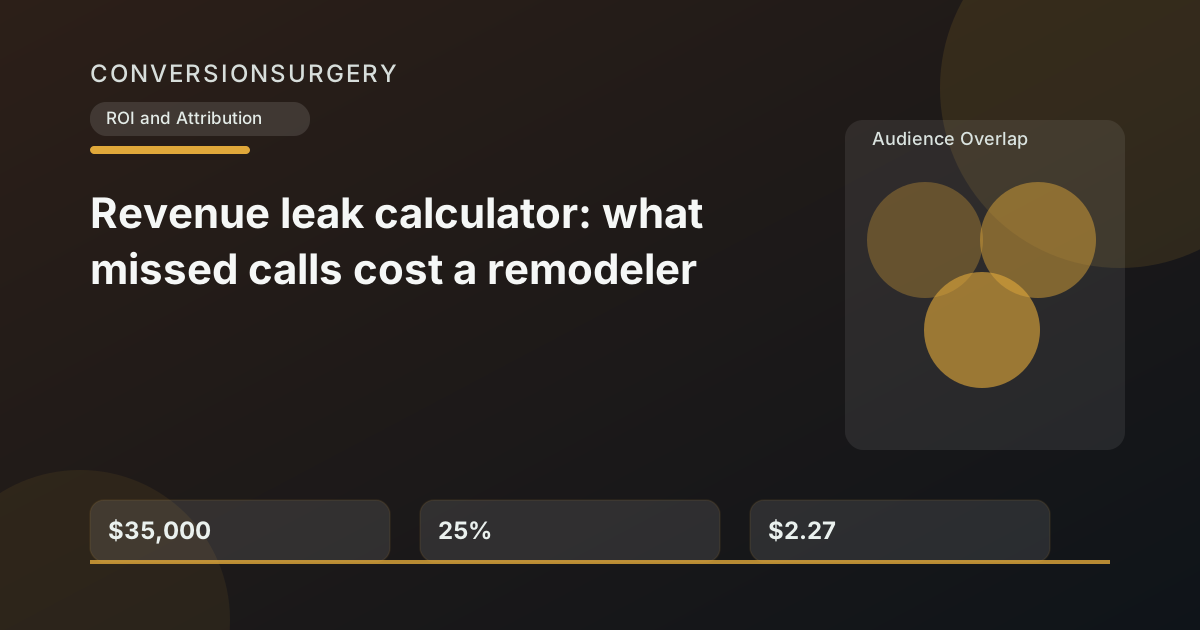
A remodeler missing five calls per week with a $35,000 average project value and a 25% close rate is leaking over $2.27 million in potential annual revenue. That’s the output of a straightforward contractor revenue loss calculation: 5 missed calls × 52 weeks × $35,000 average project × 25% expected close rate = $2,275,000 per year in jobs that went to a competitor or evaporated entirely. Most contractors know they’re losing some leads. Very few have actually run the math on what that costs them over twelve months.
Key takeaways
- Five missed calls per week at $35K average project value and 25% close rate equals $2.27 million in annual revenue exposure — even at a conservative 40% permanent loss rate, that’s $910,000/year walking out the door.
- Most contractors underestimate their missed call volume by 2–3x until they actually audit their phone logs and web form response times.
- Every permanently lost lead compounds: you lose the project, plus the referrals and repeat business that client would have generated over 3+ years.
- You can calculate your own revenue leak in under 10 minutes using three numbers you already have: missed calls per week, average project value, and close rate.
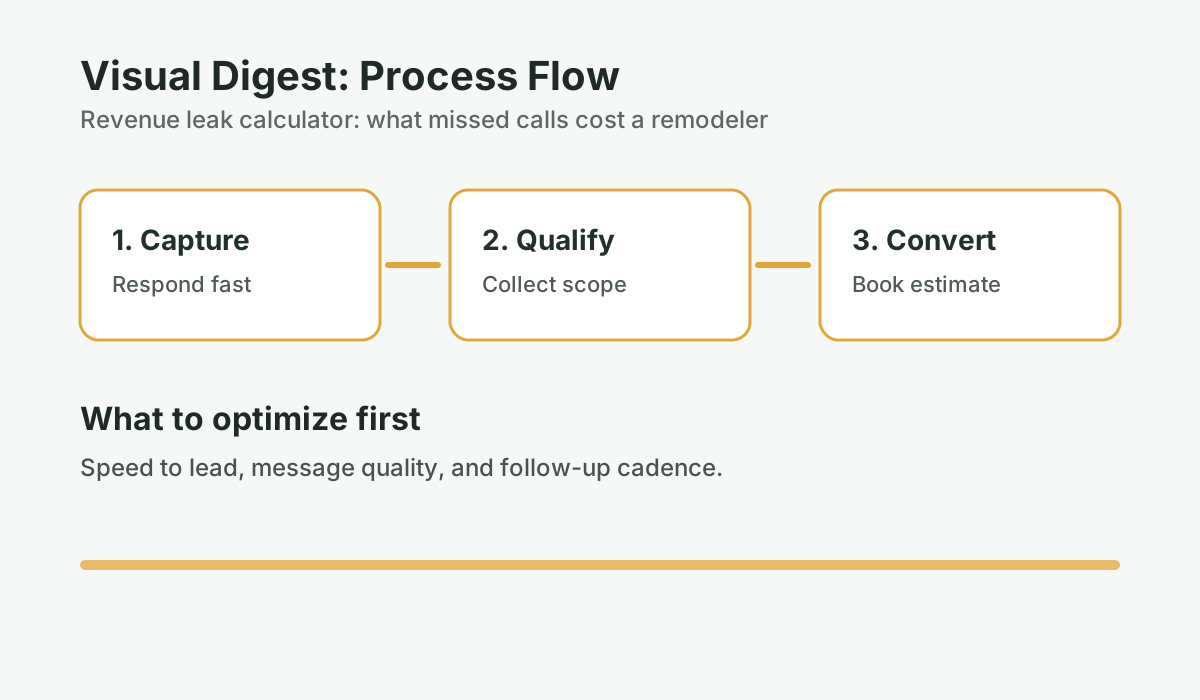
Why most contractors underestimate what missed calls cost
There’s a psychological tendency to think of each missed call as a minor inconvenience rather than a financial event. You were on a ladder. The phone rang. You couldn’t grab it. Maybe they leave a voicemail, maybe they don’t. You call back when you get a chance.
The problem is that each one of those missed calls has a dollar value attached to it — and most contractors do not add them up. When you do add them up, the total is often larger than what you’re spending on marketing, labor for a full year, or most other line items in your business.
Research consistently shows that 40–60% of contractor calls go unanswered during business hours because owners and crew are physically doing work. Source: Invoca State of the Phone Call Report, 2023 For a contractor receiving 40 inquiries per month, that’s 16 to 24 missed or significantly delayed contacts every month. To understand how these delays affect your ability to book the estimate in the first place, see why speed-to-lead is the KPI that predicts booked estimates.
How to calculate what missed calls cost your remodeling business
A revenue leak calculation for contractors quantifies the annual dollar value of jobs lost due to missed, unanswered, or slow-response leads — using your actual inquiry volume, project value, close rate, and permanent loss rate.
Here is the full calculation with real numbers so you can substitute your own figures.
Step 1: Estimate your weekly missed or slow-response leads
Count the calls and form submissions you receive in a week. Be honest about how many you answer quickly versus how many go to voicemail or sit in your inbox for an hour or more. For this example: 5 missed or slow-response contacts per week.
If you’re unsure, look at your missed calls log in your phone. Check your email for web form submissions and count how long it took you to respond. The data is already there — it just hasn’t been organized into a number.
Step 2: Apply your average project value
Use your real average — not the highest job you’ve done, and not a rough guess. Pull your last 12 months of completed jobs, add up the total revenue, and divide by the number of jobs. For this example: $35,000 average project value.
Step 3: Apply your expected close rate
Your close rate is the percentage of qualified inquiries that become signed jobs. For renovation contractors, industry benchmarks run 20–35%. Source: Remodeling Magazine Cost vs. Value Report methodology notes; ServiceTitan Benchmark Data, 2022 If you’re running lean follow-up, you’re probably at the lower end. For this example: 25% close rate.
Step 4: Annualize it
Multiply across 52 weeks:
5 missed leads/week × 52 weeks = 260 missed leads/year
260 × $35,000 = $9,100,000 in pipeline exposure
$9,100,000 × 25% close rate = $2,275,000 in lost revenue potential
That’s the annual revenue leak from five missed calls per week.
Step 5: Apply a realistic capture rate
Not every missed call is a permanent loss. Some homeowners leave a voicemail, you call back the same day, and you recover the lead. A reasonable assumption is that you recover 50–60% of missed contacts through callback. That still leaves 40–50% permanently lost to a faster competitor or to homeowner frustration.
Conservative loss (40% permanent): $2,275,000 × 40% = $910,000/year
Moderate loss (50% permanent): $2,275,000 × 50% = $1,137,500/year
Even the conservative number — $910,000 per year in permanent revenue loss from five missed calls per week — is a difficult figure to ignore.
| Missed Calls/Week | Avg Project Value | Close Rate | Annual Pipeline Exposure | Conservative Annual Loss (40%) |
|---|---|---|---|---|
| 3 | $30,000 | 25% | $2,340,000 | $234,000 |
| 5 | $35,000 | 25% | $4,550,000 | $455,000 |
| 5 | $35,000 | 25% | $2,275,000 (pipeline × close rate) | $910,000 |
| 8 | $40,000 | 30% | $6,240,000 (pipeline) | $748,800 |
| 10 | $45,000 | 28% | $6,552,000 (pipeline) | $1,833,600 (using revenue calc) |
Source: Calculation framework derived from MIT Lead Response Management Study methodology and ServiceTitan contractor benchmark data
The full revenue leak formula broken down
Here’s the complete formula in a single expression:
Annual Revenue Leak = (Missed Leads/Week × 52) × Average Project Value × Close Rate × Permanent Loss Rate
Permanent Loss Rate is the percentage of missed contacts you don’t recover through callback — typically 40–60% depending on how quickly you follow up and how competitive your market is. In Calgary and Edmonton, where multiple renovation contractors are competing for the same homeowners and several use AI response tools, the permanent loss rate trends toward the higher end.
What happens when a competitor responds to your missed call first?
The homeowner experience after submitting an inquiry is more predictable than most contractors realize. Research from Drift and InsideSales found that 78% of buyers choose the vendor who responds first. Source: Drift 2019 State of Conversational Marketing; InsideSales.com Lead Response Management research In home services, first-to-respond wins 35–50% of available jobs regardless of price or portfolio. Source: ServiceTitan Contractor Benchmark Report, 2022
This creates a dynamic where the best contractor doesn’t consistently win the job. The fastest contractor wins it — and then the best contractor’s quality shows in referrals and reviews from the jobs they do complete. The initial inquiry is decided almost entirely on speed.
The homeowner who gets a response in 30 seconds at 7 PM on Tuesday has already formed a positive impression of that contractor before hearing their voice, seeing their portfolio, or discussing pricing. The contractor who calls back Wednesday morning is playing from behind before the conversation starts. This is especially true for inquiries that arrive outside business hours — after-hours lead capture is where many of these missed calls concentrate.
What would fixing your follow-up gaps actually be worth?
Three inputs from your business. One formula. A clear picture of the revenue you could recover this year.
Run the numbers for your business: Run the Revenue Leak Scorecard. It takes 2-3 minutes and gives you a clear baseline before your next estimate round.
A worked example with real contractor numbers
Consider a representative basement-specialist scenario: roughly $1.1M annual revenue, about 35 inquiries per month, and a 24% close rate.
When we actually counted missed calls and slow responses (over an hour), we found he was missing or significantly delaying about eight inquiries per week. He’d assumed it was maybe three or four.
Running the formula:
8 missed leads/week × 52 weeks = 416 missed leads/year
416 × $35,000 average project = $14,560,000 in pipeline exposure
$14,560,000 × 24% close rate = $3,494,400 in potential revenue affected
At 40% permanent loss: $1,397,760 per year
Even at 20% permanent loss — an optimistic assumption — that’s nearly $700,000 per year in revenue leaking from slow response alone.
In modeled scenarios where a revenue recovery system is in place — with around-the-clock monitoring, responses within seconds during legally permitted messaging hours, and restricted-hour inquiries queued for the next compliant window — published benchmark analyses suggest structured response and follow-up can improve conversion outcomes over six to twelve months when fit conditions are strong. The gains come from both stronger estimate follow-up and fewer inquiries disappearing during the workday. In this modeled scenario, the implied ROI remains meaningfully positive when assumptions hold.
Why the hidden compounding cost doesn’t show up in the formula
Compounding lead loss is the downstream revenue impact beyond the initial missed project — including lost referrals, lost repeat business, and lost reviews that would have generated future inquiries.
The formula above measures direct revenue loss. There’s a second-order cost that doesn’t appear in the calculation: the compounding effect on reviews and referrals.
Every job you lose to a faster competitor is a job where the homeowner does not become a Google review source. They do not recommend you to their neighbor. They do not call you for the follow-on bathroom project. A $35,000 kitchen that went to your competitor because they responded faster isn’t just a $35,000 loss — it’s potentially a $70,000–$105,000 lifetime value loss when referral probability is factored in.
Renovation businesses grow primarily through referrals and reputation. Every missed lead is a compounding loss, not just a one-time revenue event.
How to run this calculation for your own business this week
You don’t need any software to run this. Pull three data points:
- Missed calls this week: Check your phone’s missed call log. Add any web form submissions that sat in your inbox for more than 30 minutes.
- Your average project value: Total revenue last 12 months ÷ number of completed jobs.
- Your close rate: Jobs won last 12 months ÷ estimates sent last 12 months.
Plug those into the formula: (Missed leads/week × 52) × Average Project Value × Close Rate × 0.40
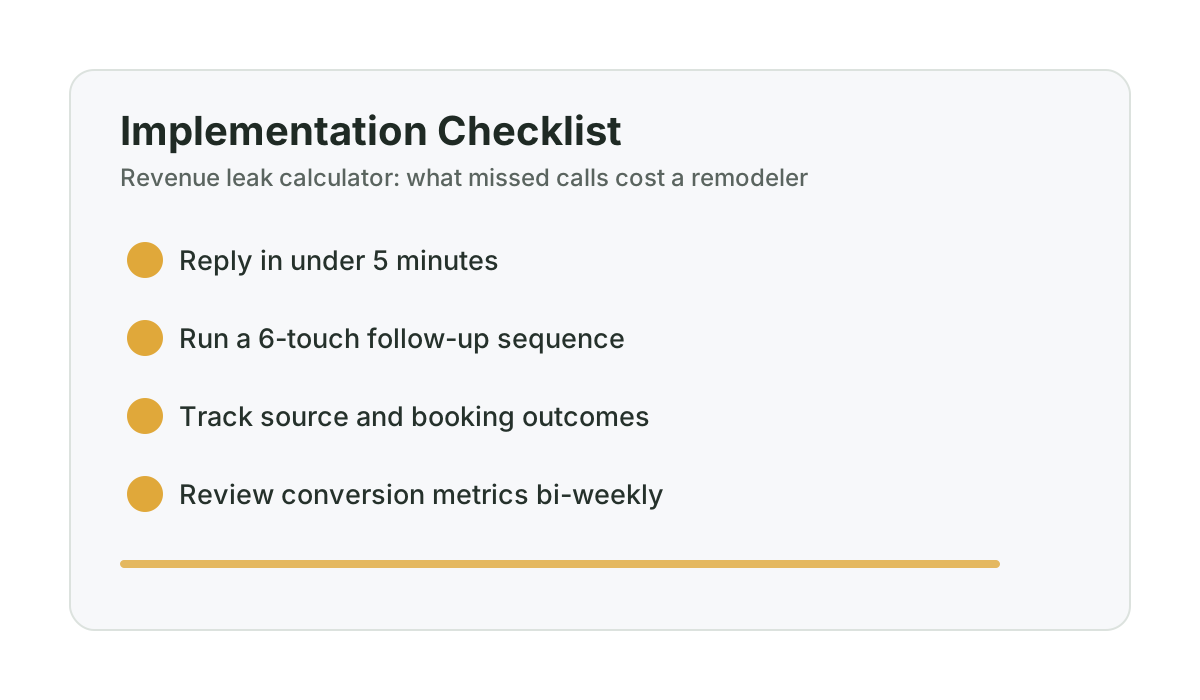
If the number you get is larger than $997/month — and for almost every contractor getting more than 15 inquiries per month with a $25,000+ average project value, it will be — the math suggests fixing this is a high-leverage decision worth prioritizing. If you want to see exactly which metrics to track once you start recovering those leads, your first ROI report will show you the revenue recovery numbers.
Frequently asked questions
What is a contractor revenue loss calculator and how do I use one?
A contractor revenue loss calculator estimates annual revenue lost to missed or slow-response leads. The formula is: (Missed Leads per Week × 52) × Average Project Value × Close Rate × Permanent Loss Rate (typically 40-50%). Plug in your actual numbers to get an estimate of how much revenue is leaking from your current lead response process.
How many calls does the average renovation contractor miss per week?
Industry data suggests 40-60% of contractor calls go unanswered during business hours because owners and crew are physically working. For a contractor receiving 30-50 inquiries per month, that translates to roughly 12-30 missed or significantly delayed contacts. Most contractors who count their missed calls for the first time discover the number is two to three times higher than they assumed.
Is my revenue leak really that large, or are these numbers inflated?
The formula includes all missed contacts multiplied by your average project value and close rate — which represents the maximum possible revenue impact. The permanent loss rate (40-50%) is the conservative adjustment for contacts you do recover through callback. If you have an unusually high callback recovery rate or a low-competition market, your actual loss may be lower. But even at 20% permanent loss, the numbers are significant for most renovation contractors with average project values above $25,000.
What’s the ROI comparison between fixing missed calls versus running more Google Ads?
Google Ads for renovation contractors typically cost $50-$150 per lead in competitive Alberta markets, with a cost per closed job of $2,000-$10,000 depending on close rate. A follow-up system at $997/month that recovers even one or two previously missed jobs per month costs $500-$1,000 per recovered job at that volume. The math often favors recovering existing leads before adding new ones — fixing the leak before turning on more water.
Does slow response hurt me even if I eventually call back?
Yes. Research from MIT shows that leads contacted after 30 minutes are 21 times less likely to qualify compared to leads contacted within 5 minutes. This is because homeowners typically contact multiple contractors simultaneously. In the 30-45 minutes between their inquiry and your callback, a competitor may have already reached them, made a strong first impression, and started booking an estimate. You’re not eliminated by calling back late, but you’re at a significant disadvantage.
Want help applying this to your pipeline?
Use the matching diagnostic tool first, then book a quick strategy call if you want a done-for-you rollout.

Mashrur Rahman
Founder, ConversionSurgery
I build revenue recovery systems for renovation contractors. After seeing how much money remodelers lose to slow follow-up and missed calls, I built a managed service that handles lead response, estimate follow-up, and after-hours capture automatically. The data in these articles comes from running these systems across real contracting businesses.
Related reading

Deposit and invoice reminder system for contractors: improve cash flow without awkward chasing
A practical automation framework for deposit and invoice reminders that improves payment speed and reduces owner stress.
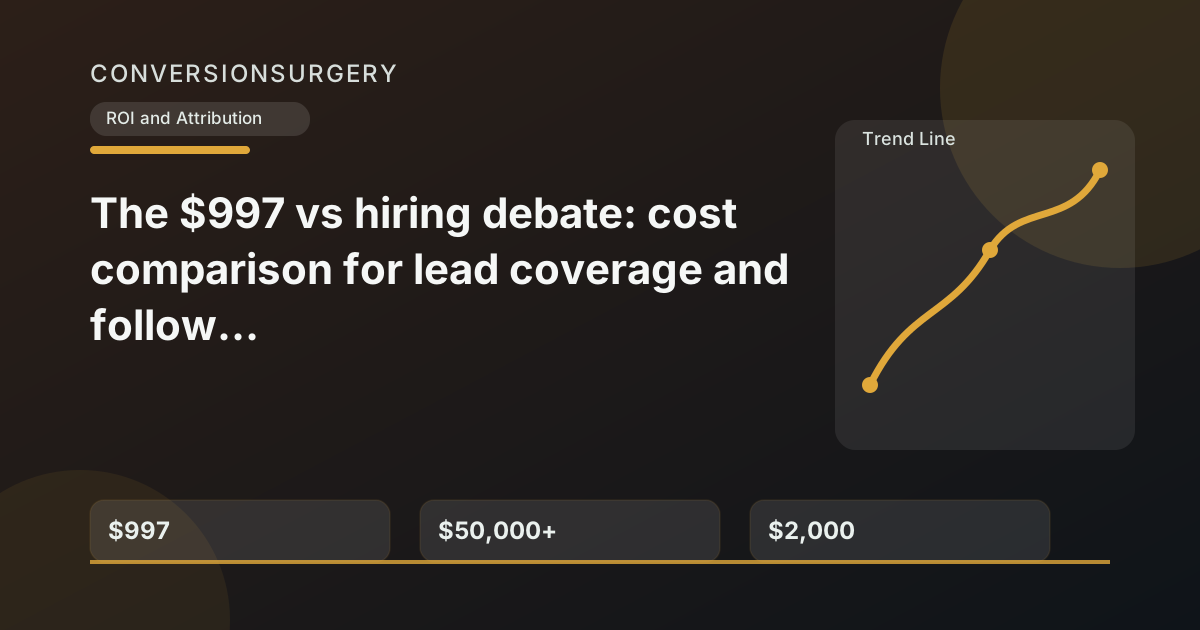
The $997 vs hiring debate: cost comparison for lead coverage and follow-up
An office admin costs $50K+/year. A VA runs $2K–$3K/month. An answering service $250–$500/month. Honest cost comparison for every option.
Marketing ROI without guesswork: from lead to booked estimate to closed job
Most contractors track spend and jobs won. Inquiry to estimate to close is where visibility disappears and money leaks. Here’s what to measure.