The missed call problem: what contractors lose when 8-12 calls go unanswered every week
Updated
There is a specific kind of revenue loss that renovation contractors rarely quantify. It is not the job that went to a lower bidder. It is not the estimate that lost on scope or timing. It is the call that rang while you were on a job site, went to voicemail, and disappeared. The homeowner moved on. You did not know they called. No record, no follow-up, no second chance. This post breaks down the published research on how many calls contractors actually miss, what happens to those callers, and what the revenue math looks like when you model it against real project values and close rates.
Key takeaways
- Published benchmarks show contractors in the $500K to $2M revenue range miss 8 to 15 inbound calls per week while on job sites.
- 85% of callers who reach voicemail do not call back, according to call tracking research from Invoca and CallRail.
- Industry response time benchmarks suggest an average contractor response time of 42 minutes — well past the window where contact rates are highest.
- Responding within 5 minutes versus 30 minutes produces a 21x higher contact rate, per InsideSales.com research.
- For a contractor with a $50,000 average project value and a 25% close rate, recovering even three to four leads per week from missed calls represents $150,000 to $200,000 in additional annual pipeline.
How many calls do contractors actually miss per week?
Contractor missed call recovery is the process of automatically capturing and responding to inbound calls that go unanswered — typically through a fast text response during legally permitted messaging hours (with restricted-hour inquiries queued to the next compliant window) or an AI-initiated conversation that qualifies the inquiry and moves the lead toward a booked estimate, rather than letting it disappear into voicemail.
The structural reality of running a renovation business is that you cannot answer your phone while you are working. You are on a ladder. You are operating a saw. You are talking to a client on site about a change order. You are managing a crew. The phone rings, and you do not answer it.
This is not a discipline problem. It is a physics problem. And it affects nearly every contractor who is still actively working job sites while also running sales.
Published benchmarks from call tracking platforms and home services industry surveys consistently show that contractors in the $500K to $2M revenue range miss 8 to 15 inbound calls per week. Source: Invoca Call Intelligence Report; ServiceTitan contractor benchmarks; industry call tracking data. The range depends on the contractor’s lead volume, the number of hours spent on site versus in the office, and whether they have any form of call coverage during business hours.
Not all of those missed calls are renovation inquiries. Some are existing clients with questions. Some are suppliers. Some are spam. But industry data suggests that roughly 40% to 60% of missed calls during business hours are genuine new inquiries — homeowners who found your business through Google, a referral, or a directory listing and are calling to discuss a project. Source: CallRail call tracking data for home services verticals; BrightLocal Local Consumer Review Survey.
That means a contractor missing 10 calls per week is likely losing four to six genuine renovation inquiries. Not leads who were tire-kicking or price-shopping. Leads who were ready to have a conversation about their project.
What happens to callers who reach voicemail?
This is where the math gets uncomfortable. The assumption most contractors operate under is: “If they really want to hire someone, they will call back.” The research does not support that assumption.
According to call tracking research, 85% of callers who reach voicemail do not call back. Source: Invoca 2023 call intelligence data; Forbes Advisor citing CallRail missed call research. They hang up. They call the next contractor on their list. They submit a form to someone else. Or they put the whole project on hold because the friction of reaching a contractor felt like too much work.
Consider what the homeowner’s experience looks like from their side. They have been browsing contractor websites for an hour. They have shortlisted three or four businesses based on reviews and portfolio photos. They call the first one — voicemail. They call the second one — voicemail. The third one answers, has a conversation, and books an estimate for Thursday.
The homeowner now has an estimate booked. They may or may not continue calling the remaining contractors on their list. Even if they do, the contractor who answered first has a structural advantage that the research quantifies clearly: the first business to have a substantive conversation with a prospective buyer wins 35% to 50% of deals in competitive home services markets. Source: Harvard Business Review, “The Short Life of Online Sales Leads” (James Oldroyd et al.).
You do not just lose the call when it goes to voicemail. You lose position. And in renovation sales, position matters because homeowners are comparing you against three to five competitors simultaneously.
Why does the 42-minute response gap matter so much?
Even when contractors do return missed calls, the timing is rarely competitive. Industry response time benchmarks suggest an average contractor response time of 42 minutes. Source: Industry response time benchmarks.
42 minutes might sound reasonable. But the research on lead response timing tells a different story. The most cited study on this topic, from InsideSales.com, found that contacting a lead within 5 minutes versus 30 minutes produces a 21x higher contact rate. Source: InsideSales.com Lead Response Management study. Not 21% higher. Twenty-one times higher.
The decay curve is steep. After 5 minutes, contact rates begin to fall. After 30 minutes, they drop sharply. After one hour, the probability of making meaningful contact with a lead drops by roughly 60% compared to a sub-5-minute response. Source: InsideSales.com; Drift Conversational Marketing research.
| Response time | Relative contact rate | What it means for contractors |
|---|---|---|
| Under 5 minutes | Baseline (highest) | First to respond in virtually every scenario; sets the frame for all comparison |
| 5 to 30 minutes | Drops to roughly 1/21 of sub-5-minute | May still connect, but another contractor has likely already started a conversation |
| 30 to 60 minutes | Continues declining | Competitive disadvantage; homeowner is deeper into other conversations |
| 1 to 4 hours | Contact rate roughly 40% of the sub-5-minute baseline | Low probability of being first; many leads already booked estimates elsewhere |
| Next day or later | Contact rate drops to a small fraction | Most leads have either hired someone or disengaged from the search entirely |
Source: Compiled from InsideSales.com Lead Response Management study; Harvard Business Review lead response research; Drift state of conversational marketing reports.
At 42 minutes average response time, the typical contractor is responding well outside the window where contact rates are competitive. And that is the average — meaning half of responses take even longer. When you factor in that many missed calls do not get returned at all, the effective response rate for the average renovation contractor is far worse than 42 minutes.
See what the numbers look like when follow-up actually happens
Download a sample results dashboard showing the metrics that matter: response time, booking rate, close rate, revenue recovered.
Run the numbers for your business: See the Results Dashboard. It takes 2-3 minutes and gives you a clear baseline before your next estimate round.
What does the revenue math actually look like?
Here is where the numbers get specific. Rather than presenting a single scenario as definitive, the model below is structured so you can run it against your own business.
The variables that matter:
- Missed calls per week: 8 to 15 for most contractors in the $500K to $2M range
- Percentage that are real inquiries: 40% to 60% based on industry call tracking data
- Inquiry-to-estimate conversion: 30% to 50% for qualified renovation inquiries (varies by market and contractor reputation)
- Estimate-to-close rate: 20% to 35% for the typical renovation contractor
- Average project value: $30,000 to $75,000 for basement, kitchen, and bathroom specialists
The model works like this: take the number of missed calls per week, filter for real inquiries, apply the conversion rates through the funnel, and multiply by your average project value.
| Variable | Conservative scenario | Mid-range scenario | Higher-volume scenario |
|---|---|---|---|
| Missed calls per week | 8 | 10 | 15 |
| Real inquiries (at 50%) | 4 | 5 | 7 to 8 |
| Would-be estimates (at 35% booking rate) | 1.4 per week | 1.75 per week | 2.5 to 2.8 per week |
| Would-be signed projects (at 25% close rate) | 0.35 per week (roughly 1.4 per month) | 0.44 per week (roughly 1.8 per month) | 0.63 to 0.7 per week (roughly 2.7 per month) |
| Lost revenue per month (at $50K avg project) | $70,000 | $90,000 | $135,000 |
| Lost revenue per year | $840,000 | $1,080,000 | $1,620,000 |
Source: Model constructed from published industry data. Missed call rates: Invoca, ServiceTitan, industry call tracking data. Inquiry-to-estimate conversion: ServiceTitan contractor benchmarks. Close rates: Remodeling Magazine industry data; NKBA contractor benchmarks. These are modeled projections, not tracked outcomes from a specific business.
A few things to note about this table. First, these are pipeline numbers — potential revenue that exits the funnel before ever becoming visible to the contractor. These are not guaranteed sales. They are leads that did not get a chance to become estimates, and estimates that did not get a chance to become projects.
Second, the numbers look large because average project values in renovation are large. When your typical project is $50,000 and you are losing one to two potential projects per month to missed calls alone, the annual impact adds up quickly. This is not a rounding error on your P&L. It is the equivalent of an entire crew’s worth of revenue disappearing without a trace.
Third — and this is the part that matters most — none of this requires additional marketing spend to fix. These are leads your marketing already generated. You already paid for the Google Ad click, the SEO ranking, or the referral that prompted the call. The leak is not at the top of the funnel. It is in the middle. If you want to run this calculation with your own numbers, the revenue leak calculator walks through the same framework with your specific inputs.
What does recovery actually look like based on the research?
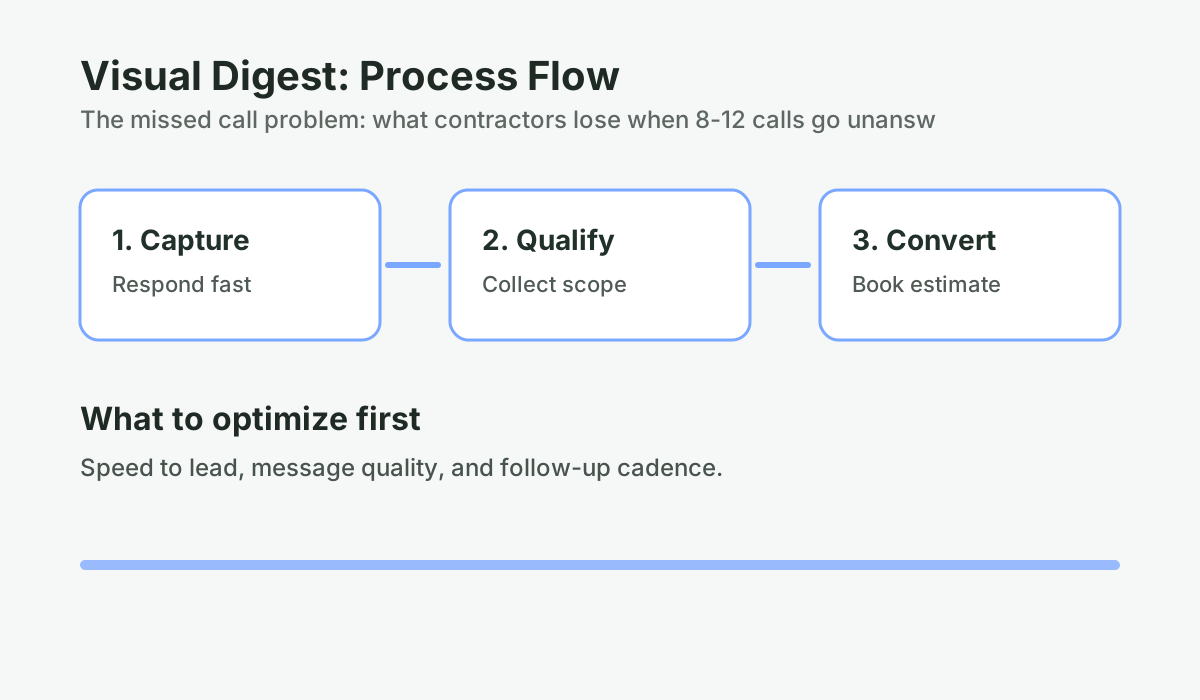
If the problem is that calls go unanswered and callers do not call back, the logical solution is to create a system that responds quickly during legally permitted messaging hours and queues restricted-hour inquiries to the next compliant window. The research supports this approach clearly.
The core mechanism of contractor missed call recovery is simple: when a call goes unanswered, an automated text message goes to the caller within seconds during legally permitted messaging hours, with restricted-hour inquiries queued for the next compliant window. That text initiates a conversation — not a generic auto-reply, but a qualifying exchange that moves the caller toward a booked estimate. The caller does not need to call back. They do not need to leave a voicemail. The conversation starts quickly, via a channel (text) that has a 98% open rate and typically gets a response within minutes. Source: Gartner SMS marketing research; SimpleTexting SMS response rate data.
Based on the research data, here is what the recovery model projects:
| Metric | Without recovery system | With under-30-second response during permitted hours | Basis |
|---|---|---|---|
| Missed calls reaching voicemail | 8 to 12 per week | 0 (all get fast text response during permitted windows) | System design |
| Callers who engage | 15% (those who call back on their own) | 45% to 65% (based on SMS engagement rates) | Gartner; SimpleTexting |
| Effective response time | 42 minutes average (when a callback happens) | Under 30 seconds during legally permitted messaging hours | Industry response time benchmarks; system spec |
| Contact rate improvement | Baseline | Up to 21x higher (5-min vs 30-min comparison) | InsideSales.com |
| First-responder competitive advantage | Rarely first (42-min average) | First in virtually every scenario | HBR lead response research |
Source: All figures derived from published research cited in this article. Recovery projections are modeled estimates based on those studies, not tracked outcomes from a specific implementation.
The practical implication: if a contractor missing 10 calls per week (five real inquiries) implements a fast text-response system that engages within 30 seconds during permitted hours and queues restricted-hour inquiries for the next compliant window, the research suggests they would engage three to four of those callers who would otherwise have disappeared entirely. Over a month, that is 12 to 16 additional conversations with potential clients. Apply a 35% booking rate and a 25% close rate, and the model projects one to two additional signed projects per month.
At a $50,000 average project value, one additional project per month is $600,000 in annual revenue that was previously invisible. The system did not generate those leads. Your existing marketing did. The system caught them before they fell through the gap between your phone ringing and your ability to answer it.
How does the first-responder advantage compound over time?
The missed call recovery math outlined above covers the direct, immediate impact: calls that would have been lost, caught instead. But the research suggests there is a compounding effect that goes beyond the immediate recovery.
When your business consistently responds first, three things happen over time:
- Higher close rates on recovered leads. Leads who have a fast, professional first interaction with your business arrive at the estimate with a different level of trust than leads you called back the next day. They have already had a conversation. They know your availability. They feel prioritized. Published data on speed-to-lead consistently shows that faster initial response correlates with higher close rates downstream — not just higher contact rates. Source: Harvard Business Review; InsideSales.com lead management research.
- Better pipeline visibility. When every inquiry enters your system instead of disappearing into voicemail, you can see the actual shape of your pipeline. You can see how many inquiries you get per week, what percentage become estimates, and where leads drop off. Contractors who cannot see this data make decisions based on gut feeling. Contractors who can see it make decisions based on evidence.
- Reduced time on manual follow-up. The hours most contractors spend on phone tag, manual callbacks, and tracking down people who inquired last week — that time gets recovered. Industry data suggests contractor owners spend four to eight hours per week on manual lead follow-up. Source: ServiceTitan contractor time study data; Jobber contractor productivity benchmarks. An automated recovery system handles the initial capture and qualification, leaving the contractor to focus on estimating, project management, and the conversations that require a human.
These compounding factors mean the total revenue impact of contractor missed call recovery is typically larger than the immediate per-lead math suggests. You are not just catching leads that would have been lost. You are improving the conversion rate on those leads and freeing up time that gets redeployed into higher-value activities.
What should a contractor evaluate before investing in missed call recovery?
Not every contractor needs a missed call recovery system. If you are a one-person operation doing $150,000 a year and getting three to four inquiries per week, the math does not justify the investment. The system matters when the volume of missed calls creates a meaningful gap between the leads your marketing generates and the leads your business actually captures.
A practical calculation to run before making any decision:
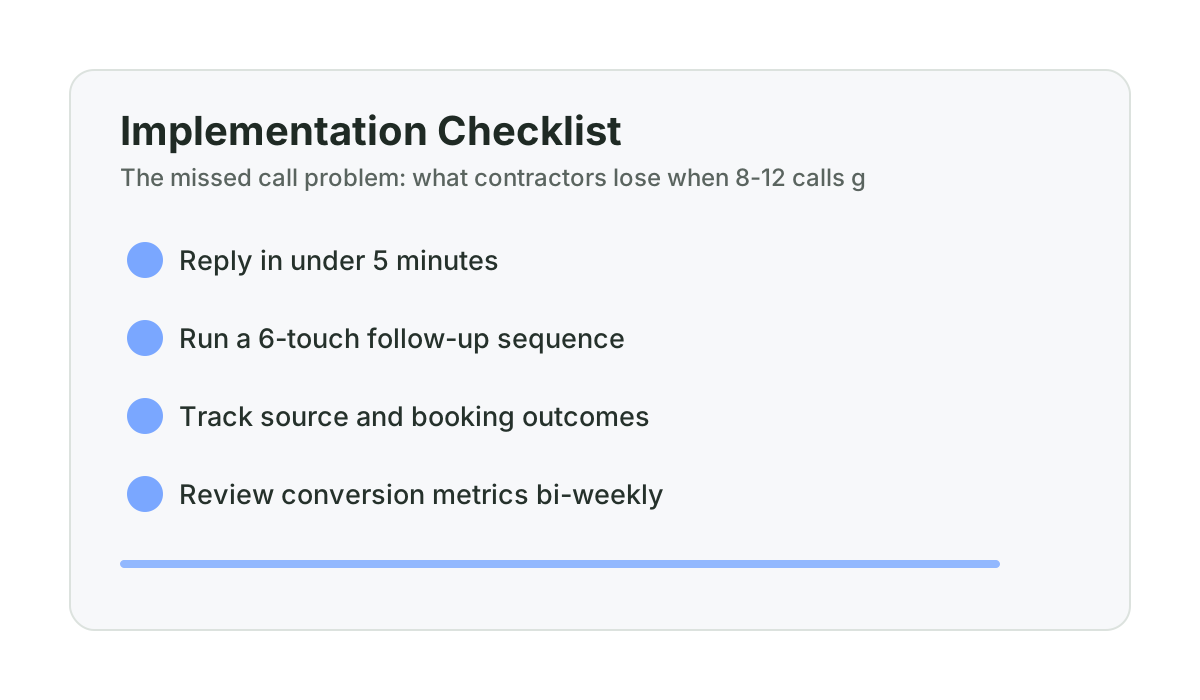
- Count your missed calls for one week. Not with software — just notice. Every time your phone rings and you do not answer it, make a note. Most teams are surprised by the number.
- Estimate the percentage that are real inquiries. Exclude known clients, suppliers, and obvious spam. Use 40% to 60% if you are unsure — that is the published range.
- Apply your normal conversion rates. What percentage of inquiries become estimates? What percentage of estimates become signed projects? Use your actual numbers, not aspirational ones.
- Multiply by your average project value. This gives you the approximate monthly revenue you are losing to missed calls.
- Compare that number to the cost of a recovery solution. If the lost revenue is 5x or more than the system cost, the math is straightforward.
For most contractors in the $500K to $2M range — the ones missing 8 to 15 calls per week with average project values of $30,000 to $75,000 — the math works clearly. One recovered project typically covers two to four years of system cost. That is not a speculative return. It is the arithmetic of catching leads that are already calling you.
The decision framework is not complicated: are you losing enough calls to justify the cost of not losing them? For most busy contractors, the answer becomes clearer once they count. If you want to see how the managed service option compares to hiring someone to handle this in-house, the managed service vs. hiring cost comparison breaks down the real numbers. And if your biggest gap is specifically after-hours and weekend leads, the after-hours lead capture guide covers that narrower problem in depth.
Why do contractors underestimate missed call losses?
There is a cognitive bias at work here that makes this problem particularly hard to see. The leads you miss are invisible. They do not show up in your CRM. They do not appear on any report. There is no lost-lead column in your accounting software.
The jobs you win are visible. The jobs you bid on and lose are visible — you know the homeowner went with someone else. But the jobs where the homeowner called, reached voicemail, and moved on without ever identifying themselves? Those are a complete blind spot.
This creates a consistent pattern: contractors who have not tracked their missed calls estimate the problem at two to three calls per week. When they actually count for a week, the number is typically three to four times higher. The gap between perception and reality exists because you can only perceive the calls you are aware of missing — and by definition, most missed calls happen when you are too busy to notice.
The research-based framework in this post is not a sales pitch for any specific tool. It is a diagnostic. The numbers come from published industry studies, not from proprietary data. The revenue model uses standard conversion rates that you can verify against your own business metrics. The only question is whether the gap between the leads your marketing generates and the leads your business captures is large enough to justify closing it.
For most contractors doing $500K or more in annual revenue, with an owner who is still actively working job sites, the data says it is. That is a mathematical observation, not a recommendation. Run the numbers for your own business and decide. The missed call recovery two-text playbook covers the tactical implementation if you decide the gap is worth closing.
Frequently asked questions
How many calls does the average renovation contractor miss per week?
Published benchmarks from call tracking platforms show that contractors in the $500K to $2M revenue range who are actively working job sites typically miss 8 to 15 inbound calls per week. Of those, roughly 40% to 60% are genuine new renovation inquiries based on industry call tracking data from Invoca, CallRail, and ServiceTitan.
What percentage of missed calls result in lost leads?
According to call tracking research from Invoca and Forbes Advisor citing CallRail data, 85% of callers who reach voicemail do not call back. Combined with the fact that the first business to respond wins 35% to 50% of deals in home services (Harvard Business Review), the majority of missed calls represent permanently lost opportunities rather than temporary delays.
How quickly should a contractor respond to a new lead?
Research from InsideSales.com shows that contacting a lead within 5 minutes versus 30 minutes produces a 21x higher contact rate. Industry response time benchmarks suggest an average contractor response time of 42 minutes. Responding in under 5 minutes — ideally under 1 minute — places a contractor first in virtually every competitive scenario.
What is contractor missed call recovery and how does it work?
Contractor missed call recovery is a system that automatically responds to unanswered calls — typically by sending a fast text response within seconds during legally permitted messaging hours, with restricted-hour inquiries queued for the next compliant window. Rather than leaving the caller with voicemail, the system initiates a text conversation that qualifies the inquiry and moves the lead toward a booked estimate. This closes the gap between the call coming in and the contractor being available to respond.
How much revenue can a contractor recover by fixing their missed call problem?
The revenue impact depends on call volume, project values, and close rates. A contractor missing 10 calls per week (five real inquiries at 50%), with a 35% booking rate, 25% close rate, and $50,000 average project value, is losing approximately $90,000 per month in potential pipeline. Recovering even a fraction of those leads — one to two additional projects per month — represents $600,000 to $1.2 million in annual revenue that the contractor’s marketing already paid to generate.
Is missed call recovery worth the investment for smaller contractors?
The math depends on volume and project value. For contractors doing under $300K annually with fewer than five inquiries per week, the investment may not justify itself. For contractors in the $500K to $2M range who are actively on job sites and missing 8 to 15 calls per week, one recovered project at a typical $30,000 to $75,000 project value covers two to four years of system cost. The break-even threshold is low when average project values are high.
Want help applying this to your pipeline?
Use the matching diagnostic tool first, then book a quick strategy call if you want a done-for-you rollout.

Mashrur Rahman
Founder, ConversionSurgery
I build revenue recovery systems for renovation contractors. After seeing how much money remodelers lose to slow follow-up and missed calls, I built a managed service that handles lead response, estimate follow-up, and after-hours capture automatically. The data in these articles comes from running these systems across real contracting businesses.
Related reading
Alberta contractor lead report template: the “without us” line that improves retention
A practical reporting template that makes ongoing system value visible to contractor owners every two weeks.
Calgary vs Edmonton renovation conversion benchmarks: answer rate, speed, and close-rate realities
A practical city comparison to help Alberta contractors set realistic speed and conversion targets by market conditions.
How renovation contractors use Google reviews to win more estimates in Alberta
A review engine for Alberta remodelers: request timing, response templates, and GBP visibility impact on estimate bookings.