The $997 vs hiring debate: cost comparison for lead coverage and follow-up
Updated
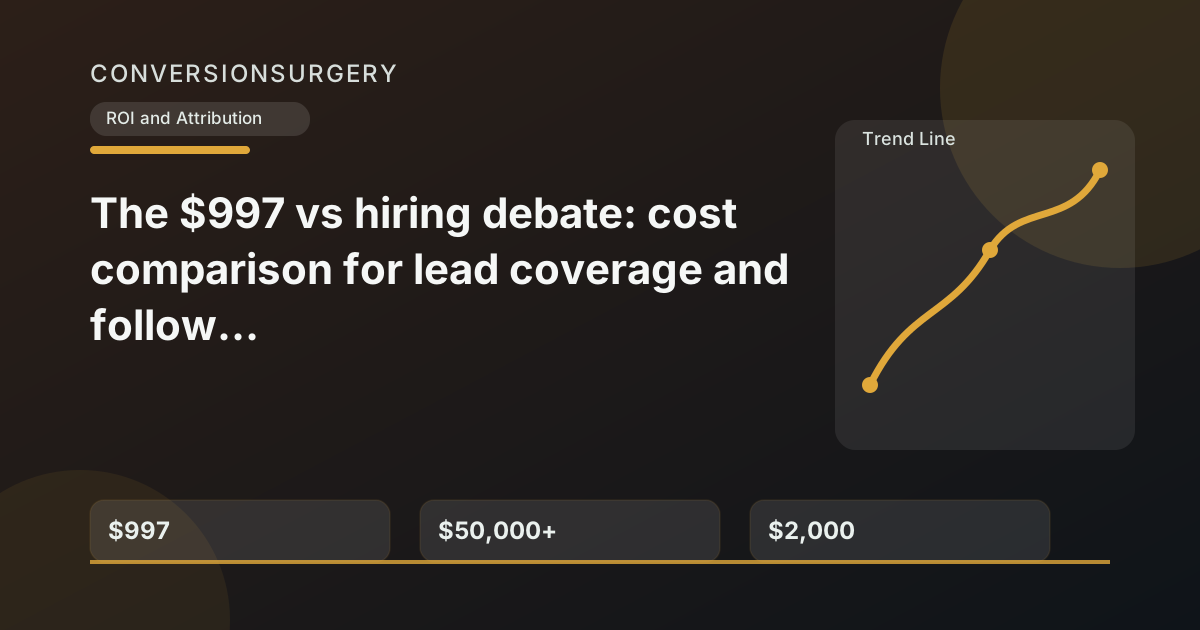
When a renovation contractor realizes they’re losing jobs to slow response and inconsistent follow-up, they face a genuine hiring versus automation decision. The options are a full-time office admin ($50,000+ per year), a virtual assistant ($2,000–$3,000 per month), a traditional answering service ($250–$500 per month), or a managed AI system ($997 per month). Each has real trade-offs. This post breaks down the honest cost comparison — not to sell you on any one option, but to help you understand what you’re actually comparing and which solution fits your situation.
Key takeaways
- There are three separate problems contractors lump into “I need someone to handle the phones”: speed of first response, after-hours coverage, and estimate follow-up persistence — different solutions handle each one differently.
- A full-time office admin ($50K–$70K/year) is the highest-capability option but requires management bandwidth and doesn’t cover evenings, weekends, or holidays.
- A managed AI system at $997/month needs to recover just 0.3 additional jobs per year at $40K average project value to break even — less than one-third of a single kitchen project.
- For contractors between $500K and $1.5M in revenue, the managed AI system typically delivers the highest ROI because the biggest revenue leak is response speed and follow-up consistency, not administrative capacity.
- These options aren’t mutually exclusive: at $1.5M+ revenue, pairing a managed AI system with a part-time admin covers both lead response and broader operational needs.
What problem is each contractor lead coverage option solving?
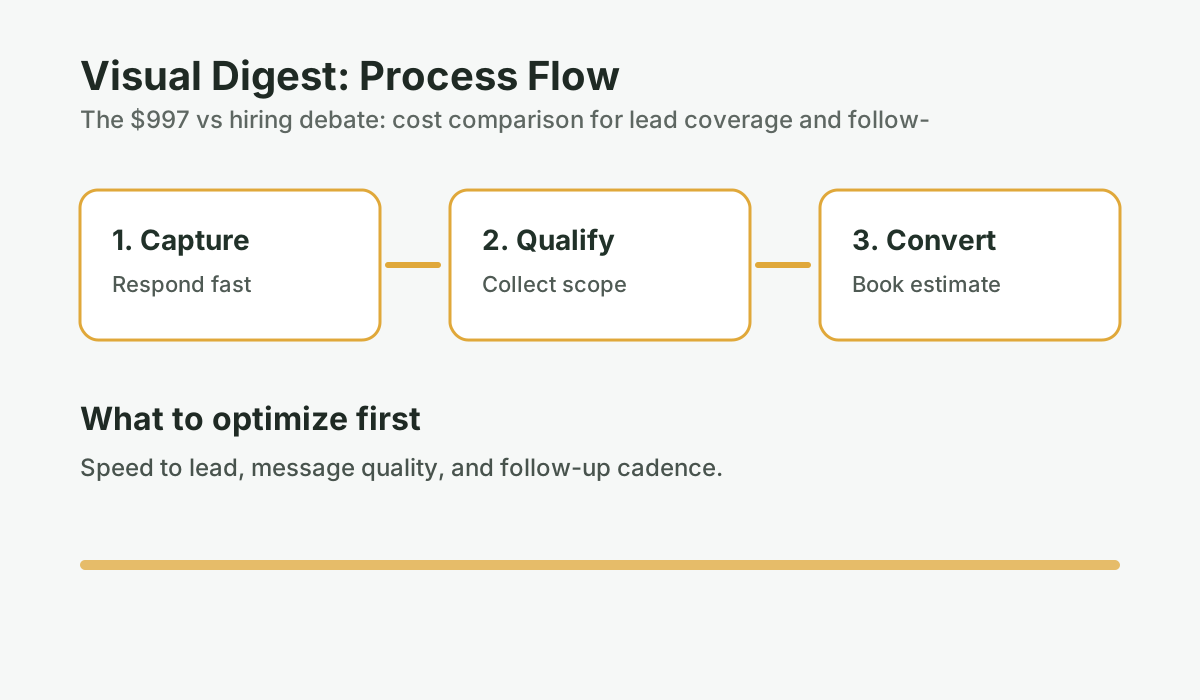
Before comparing costs, it’s worth being precise about the problem. There are actually three separate problems that often get lumped into “I need someone to handle the phones”:
- Speed of first response — Replying to inquiries within minutes, not hours
- After-hours and weekend coverage — Capturing a 9 PM Saturday inquiry and engaging it at the next permitted window without manual follow-up
- Estimate follow-up persistence — Following up six to eight times over six weeks after sending an estimate
Different solutions handle these three problems differently. An answering service handles #1 during business hours reasonably well. It handles #2 for phone calls only. It does nothing for #3. A full-time office admin can handle all three — if they’re well-trained, motivated, and employed consistently. A managed AI system monitors all three around the clock, with rapid responses during permitted hours.
The right comparison depends on which of these three problems is costing you the most revenue.
Option 1: Full-time office admin
Annual cost: $50,000–$70,000 in total compensation
An office admin in Alberta earning market wages will cost roughly $40,000–$55,000 in base salary plus employer-side CPP contributions (approximately 5.95% on insurable earnings), EI premiums (approximately 2.28%), and any benefits you provide. Total employment cost including mandatory contributions typically runs $47,000–$65,000 per year for a full-time administrative role. Source: Government of Canada Employment Insurance Premium Rates; Canada Pension Plan contribution rates; Statistics Canada Labour Market Survey 2023–2024 for Alberta administrative wages
What you get: A person who can handle incoming calls, book estimates, follow up on outstanding estimates, manage your CRM, and act as a general business administrator. If you find the right person and train them well, this is genuinely the most capable option.
What you don’t get: Coverage after 5 PM and on weekends (unless you pay overtime or hire multiple people). Sub-minute response during legally permitted messaging windows when they’re on a call with someone else. Immunity from turnover, sick days, and performance variability. Consistency — a good admin follows up on estimates, a bad one doesn’t, and often you won’t know which you have until you’ve lost jobs.
Honest trade-off: If you’re doing $1.5M+ per year, have a high enough inquiry volume to keep an admin fully occupied, and have the management bandwidth to hire, train, and retain someone, a well-placed office admin is the highest-capability option. The problem is the cost, the management overhead, and the dependency on a single person. At $50,000–$70,000 per year, this is a substantial fixed cost commitment that requires strong lead volume to justify.
Option 2: Virtual assistant (VA)
Monthly cost: $1,500–$3,500/month depending on hours and specialization
A virtual assistant from the Philippines, Latin America, or Eastern Europe working 20–40 hours per week typically costs $5–$15 per hour, putting monthly costs at $400–$2,400 for a part-time arrangement. A specialized VA with experience in contractor follow-up or CRM management commands $15–$25/hour, pushing monthly costs to $1,200–$4,000 for full-time equivalent. Source: Upwork Freelancer Rates Index 2023; Remote.com Global Salary Guide 2024
What you get: Human judgment, the ability to handle complex or unusual conversations, and the flexibility to adapt to situations outside a defined script. A well-trained VA can manage your CRM, follow up on estimates in your voice, handle scheduling, and do administrative tasks an AI can’t.
What you don’t get: reliable around-the-clock monitoring and rapid responses during permitted hours. Fast response during permitted messaging windows — a VA in a different time zone may be asleep when a Saturday night inquiry comes in. Reliability — VA turnover is high and training time is significant. When your VA leaves, you start over. You also still need to manage them: answer their questions, review their work, and catch their mistakes.
Honest trade-off: VAs are best for daytime administrative tasks that require human judgment — scheduling, CRM management, coordinating with suppliers. They are a poor fit for lead response and compliant after-hours coverage because the speed advantage disappears when you need it most: evenings and weekends, when 25–40% of renovation inquiries arrive. Source: industry call tracking data; BrightLocal Local Consumer Review Survey
Option 3: Traditional answering service
Monthly cost: $250–$500/month for basic service; $500–$1,500/month for appointment booking
Traditional answering services employ live agents who answer calls when you can’t. Basic services take a message and text or email it to you. Premium services attempt to book appointments into your calendar.
What you get: A human answers the phone around the clock for inbound calls. For homeowners who called because they want to speak to a person quickly, this can be a meaningful advantage over automated responses. For a deeper dive into whether live answering actually outperforms a callback system for contractor inquiries, see the live answering vs. callback comparison.
What you don’t get: Agents who know your business. Every call is handled by someone reading from a script who has no context about your services, pricing approach, or typical projects. They take messages. They don’t qualify leads. They don’t book estimate appointments into your actual calendar with any reliability. They don’t follow up on estimates after the first contact. Per-minute billing models can also make costs unpredictable during busy periods.
Honest trade-off: Answering services solve one narrow problem: making sure a human voice answers your phone. They don’t solve estimate follow-up, after-hours web form response, CRM management, appointment reminders, or any of the downstream stages that also determine whether you close jobs.
What would fixing your follow-up gaps actually be worth?
Three inputs from your business. One formula. A clear picture of the revenue you could recover this year.
Run the numbers for your business: Run the Revenue Leak Scorecard. It takes 2-3 minutes and gives you a clear baseline before your next estimate round.
Option 4: Managed AI system (e.g., ConversionSurgery Revenue Recovery System)
Monthly cost: $997/month
A managed AI system like the Revenue Recovery System combines an AI Conversation Agent with automated follow-up sequences, CRM management, appointment booking, and bi-weekly optimization — all set up and run for you. The distinction from a SaaS product is that you don’t configure it or manage it yourself. It operates in your voice, on your business logic, with your escalation thresholds.
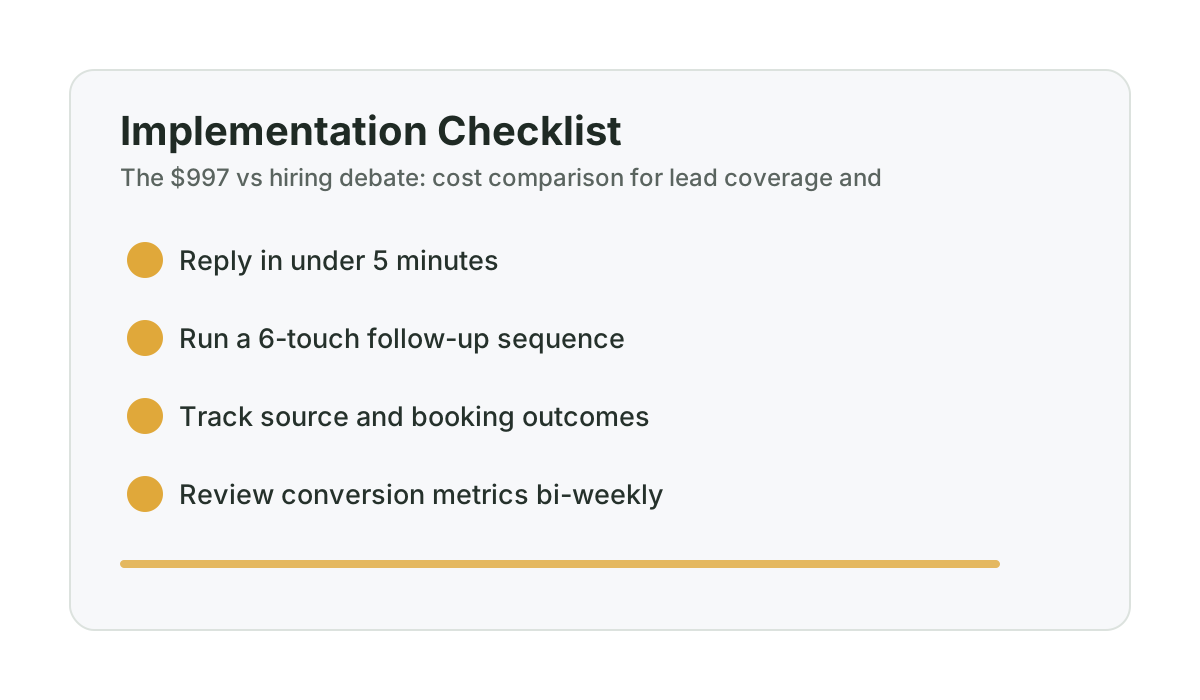
What you get: Around-the-clock inquiry monitoring, responses within seconds during legally permitted messaging hours, and queued handling for restricted-hour inquiries at the next compliant window. Consistent six-to-eight touch estimate follow-up over six weeks without you having to think about it. Appointment reminders that reduce no-show rates. CRM visibility into every lead status. Bi-weekly performance reports. A 30-day Proof-of-Life guarantee: if you don’t see at least 5 Qualified Lead Engagements in the first 30 days, your first month is refunded.
What you don’t get: A human who can handle unusual situations outside the system’s defined parameters. The AI has guardrails — it won’t make pricing promises, won’t handle complex legal or technical questions, won’t escalate judgment calls the way a human would. For situations outside the norm, it defers to you. If you’re wondering what the first week of setup actually looks like, the done-for-you week one walkthrough covers every step.
Honest trade-off: The managed AI system is optimized for the specific problem it solves — speed of first response, after-hours coverage, and estimate follow-up persistence. It handles those three things better than any human can at this price point. It does not replace the judgment, flexibility, and relationship-building that a well-placed office admin provides. If your business needs broader administrative support — scheduling crews, managing supplier relationships, handling complex client communication — a managed AI system is one piece of the solution, not the whole thing.
How does each contractor lead coverage cost compare?
Contractor lead coverage cost is the total monthly or annual expense of ensuring every inbound inquiry receives a timely response, including first-response speed, after-hours availability, and persistent estimate follow-up across all contact channels.
| Option | Monthly Cost | Annual Cost | Response Speed | Estimate Follow-Up | After-Hours Coverage | Management Required |
|---|---|---|---|---|---|---|
| Full-time office admin | $4,200–$5,800 | $50,000–$70,000 | No (business hours only) | Yes, if trained | No | High — hiring, training, management |
| Virtual assistant (part-time) | $1,500–$3,500 | $18,000–$42,000 | No (time zone dependent) | Yes, if trained | Limited | Medium — daily oversight needed |
| Traditional answering service | $250–$1,500 | $3,000–$18,000 | Yes (calls only) | No | Calls only | Low — but limited capability |
| Managed AI system ($997/month) | $997 | $11,964 | Yes (all channels) | Yes (automated, 6–8 touches) | Yes (all channels, with around-the-clock monitoring, legally compliant response windows, and restricted-hour queueing) | Minimal — read bi-weekly reports |
Source: Government of Canada employer contribution rates; Statistics Canada Alberta wage data; Upwork Freelancer Rate Index 2023; answering service industry pricing research
What is the break-even for each option?
Break-even for a lead coverage investment is the number of additional closed jobs required for the recovered revenue to equal the annual cost of the system or hire — expressed as a fraction of your average project value.
Every option should be evaluated against the revenue it recovers, not just its cost.
A full-time admin at $60,000/year needs to recover roughly $60,000 in additional revenue per year to break even — about 1.5 additional closed jobs at $40,000 average project value. If they’re doing their job well, they’ll likely do that. But the question is whether they will consistently, and whether the management overhead is worth it to you at your current stage of business.
A managed AI system at $997/month needs to recover $11,964 per year to break even — roughly 0.3 additional closed jobs at $40,000 average project value. Less than one-third of a single kitchen project. Use your own inputs and validate with conservative assumptions.
Benchmark analyses suggest that structured lead capture and follow-up systems can improve revenue outcomes over six to twelve months when fit conditions are strong. In modeled scenarios where previously missed inquiries are captured and followed up consistently, ROI can be material. Treat this as directional until validated with your own reporting. You can see the metrics behind results like this in contractor benchmarks for answer rate, booking rate, and speed.
Which option is right for your business?
Here’s how I’d think about the decision:
Under $600K/year, fewer than 20 inquiries/month: A managed AI system is probably the right starting point. The cost is manageable, it handles the core problems of response speed and follow-up, and you don’t have the inquiry volume to justify a human hire yet.
$800K–$1.5M/year, 20–60 inquiries/month: This is the primary sweet spot for managed AI. You have enough lead volume that missed inquiries represent material revenue, but you probably don’t have the administrative infrastructure or management bandwidth for a full-time hire. Run the break-even math with your own lead volume, close rate, and project values before deciding.
$1.5M+/year with complex admin needs: You may want a part-time VA or office admin for administrative tasks beyond lead response and follow-up — crew coordination, supplier management, complex client communication. A managed AI system handles the lead response and follow-up layer while the human handles everything else. These aren’t mutually exclusive.
The honest answer to “should I hire or automate?” is: it depends on where your revenue leak is. If you’re losing jobs primarily to slow response and missed estimate follow-up — which is common across renovation contractors in published benchmark studies — a managed system solves the specific problem at a fraction of the cost of a hire. If you need broader operational support, the calculus changes.
Frequently asked questions
Is hiring an office admin or using automation better for contractor lead follow-up?
It depends on the specific problem. For speed of first response, after-hours coverage, and systematic estimate follow-up, a managed AI system outperforms a human hire at this price point because it delivers around-the-clock monitoring with rapid responses during permitted hours and no staffing variability. For complex administrative tasks requiring judgment — crew coordination, nuanced client communication, supplier management — a human is better. For most contractors in the $500K–$2M range, the largest revenue leak is in first response speed and follow-up consistency, which makes automation the higher-ROI initial investment.
What does a virtual assistant actually cost for a renovation contractor?
A part-time VA (20 hours/week) with general administrative skills typically costs $800–$1,600/month from offshore hiring platforms. A VA with specific contractor CRM or follow-up experience runs $1,500–$3,500/month. Factor in 10–20 hours of your own time for training and oversight in the first few months, plus the probability of turnover requiring you to restart that process. All-in cost for the first year is typically higher than the hourly rate suggests.
Can an answering service replace AI for lead response?
For the narrow problem of having a human voice answer your phone during business hours, yes. For everything else — after-hours web form response, weekend text inquiries, estimate follow-up sequences, CRM management, appointment reminders — no. Answering services solve one stage of the funnel (initial phone response) and leave the remaining stages unaddressed. Most contractors who rely on answering services still lose the majority of their after-hours inquiries and don’t follow up on estimates consistently.
How many jobs do I need to recover to justify a $997/month follow-up system?
At $997/month, the annual cost is $11,964. At an average project value of $40,000, you need to recover 0.3 additional jobs per year to break even — less than one-third of a single job. For teams with 15+ monthly inquiries and strong execution discipline, break-even can happen quickly. Validate this with your own before/after conversion data rather than assumed outcomes.
What are the real downsides of using AI instead of a human for lead follow-up?
AI follow-up systems handle routine conversations well but have limitations with unusual situations. An AI won’t exercise judgment about whether to persist or back off with a particular homeowner the way an experienced salesperson would. It won’t recognize emotional cues the way a human does. And if your business has highly variable pricing, complex project scoping conversations, or clients who need significant hand-holding early in the process, an AI handles the initial response and qualification but a human still needs to take over for the deeper conversation. The honest assessment is that AI is excellent at the repetitive, high-volume, time-sensitive parts of lead management — and those happen to be the parts where most contractors currently have the largest gaps.
Want help applying this to your pipeline?
Use the matching diagnostic tool first, then book a quick strategy call if you want a done-for-you rollout.

Mashrur Rahman
Founder, ConversionSurgery
I build revenue recovery systems for renovation contractors. After seeing how much money remodelers lose to slow follow-up and missed calls, I built a managed service that handles lead response, estimate follow-up, and after-hours capture automatically. The data in these articles comes from running these systems across real contracting businesses.
Related reading
Deposit and invoice reminder system for contractors: improve cash flow without awkward chasing
A practical automation framework for deposit and invoice reminders that improves payment speed and reduces owner stress.
Marketing ROI without guesswork: from lead to booked estimate to closed job
Most contractors track spend and jobs won. Inquiry to estimate to close is where visibility disappears and money leaks. Here’s what to measure.
What’s a lead worth in renovation? Valuing your pipeline using real project costs
A kitchen remodeling lead is worth $8K–$12K in expected revenue. Knowing your lead value changes how you make decisions about every inquiry you receive.