Live answering vs callback: what really happens when calls go unanswered
Updated
When a homeowner calls a contractor and no one answers, there are exactly six things that can happen next: nothing, voicemail, a callback attempt, an automatic text, a live answering service, or an AI response. Each one produces a different outcome — and the differences in lead conversion rate between best and worst are significant enough to materially affect annual revenue. This post breaks down each option with honest numbers so you can decide what level of coverage actually makes sense for your business.
Key takeaways
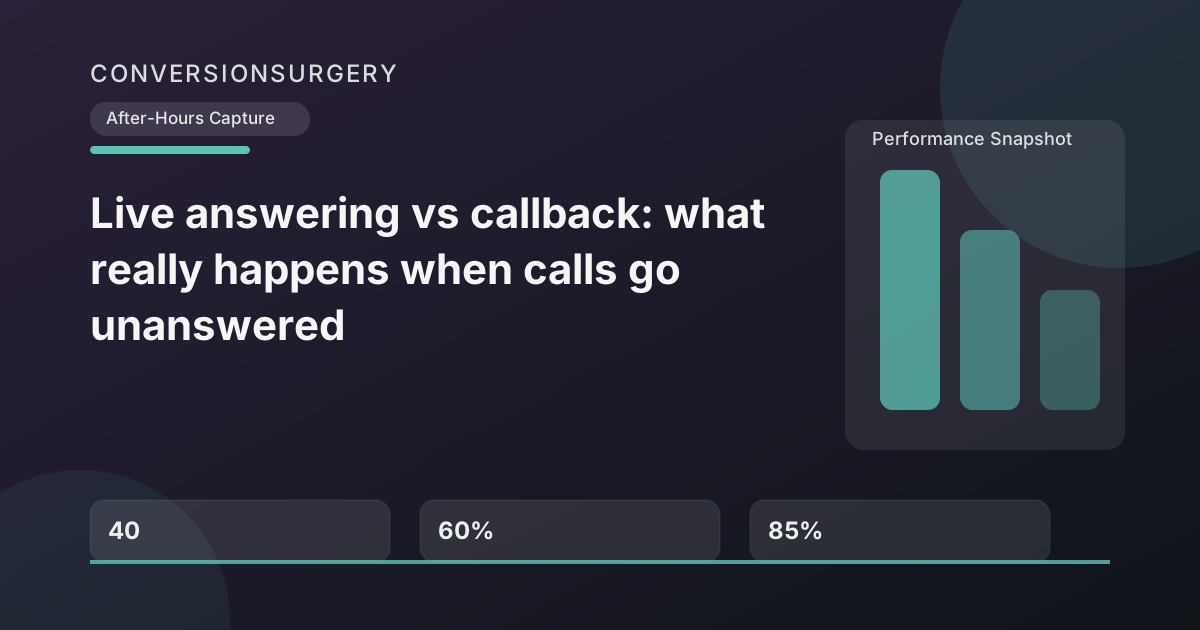
- 40–60% of calls to contractors go unanswered during business hours, and 85% of callers who hit voicemail do not leave a message.
- The six unanswered-call options range from 10% lead capture (doing nothing) to 60–80% (AI response system) — a difference that can mean hundreds of thousands in annual revenue.
- Live answering services take messages but don’t book estimates — you still need to call back, and by then the lead is often gone.
- An AI response system qualifies leads, answers business questions, and books estimates with around-the-clock monitoring, legally compliant response windows, and restricted-hour queueing at a flat monthly rate.
- At typical renovation ticket sizes, one recovered project can offset multiple months of service cost.
How big is the unanswered call problem for contractors?
Unanswered contractor calls are inbound phone calls from prospective customers that ring to voicemail or go unacknowledged — representing the largest single source of invisible lead loss in home service businesses.
Before comparing solutions, start by measuring your own missed-call and missed-form rate over the last 30 days. Many contractors discover a meaningful share of inquiries are unanswered during business hours because the owner is on site, in transit, or mid-installation.
When callers hit voicemail, a large portion move to the next contractor quickly instead of waiting. Treat voicemail-only handling as a leakage risk and verify this with your own call logs and missed-call callbacks.
The question isn’t whether you’re losing calls. You are. The question is what you’re doing about it.
Option 1: Do nothing
The most common approach, though no contractor would describe their strategy this way. The phone rings, goes to voicemail, the caller hangs up, and the event is not logged. You do not know how many leads this represents.
Lead capture rate: 10–15% (the rare caller who leaves a voicemail and you actually call back in time)
Cost: $0 in direct costs. Substantial in lost revenue.
The real problem: You have no data. You don’t know how many calls you missed. You can’t measure what you’re losing. Most contractors who “do nothing” underestimate their miss rate by 50% or more. A revenue leak calculator can put a dollar figure on what those missed calls are actually costing you.
Option 2: Voicemail (standard)
You set up a professional voicemail greeting and hope callers leave a message. Some do. Most don’t.
Lead capture rate: 15–20% (those who leave voicemails and get a timely callback)
Cost: ~$0 incremental
The problem: 85% of callers who hit voicemail hang up without leaving a message. Of those who do leave a message, many will have already called a competitor by the time you call back — especially if this happens after hours. Voicemail is marginally better than nothing because at least some leads self-select by leaving a message. But it’s capturing the bottom of the barrel: the small minority willing to wait.
Option 3: Manual callback system
You (or a staff member) actively monitor missed calls and call back within a defined window — for example, within two hours during business hours.
Lead capture rate: 25–40% (depends heavily on how quickly you call back)
Cost: Your time or part of a staff member’s time. If owner-managed: high opportunity cost. If staff-managed: $15–$25/hour.
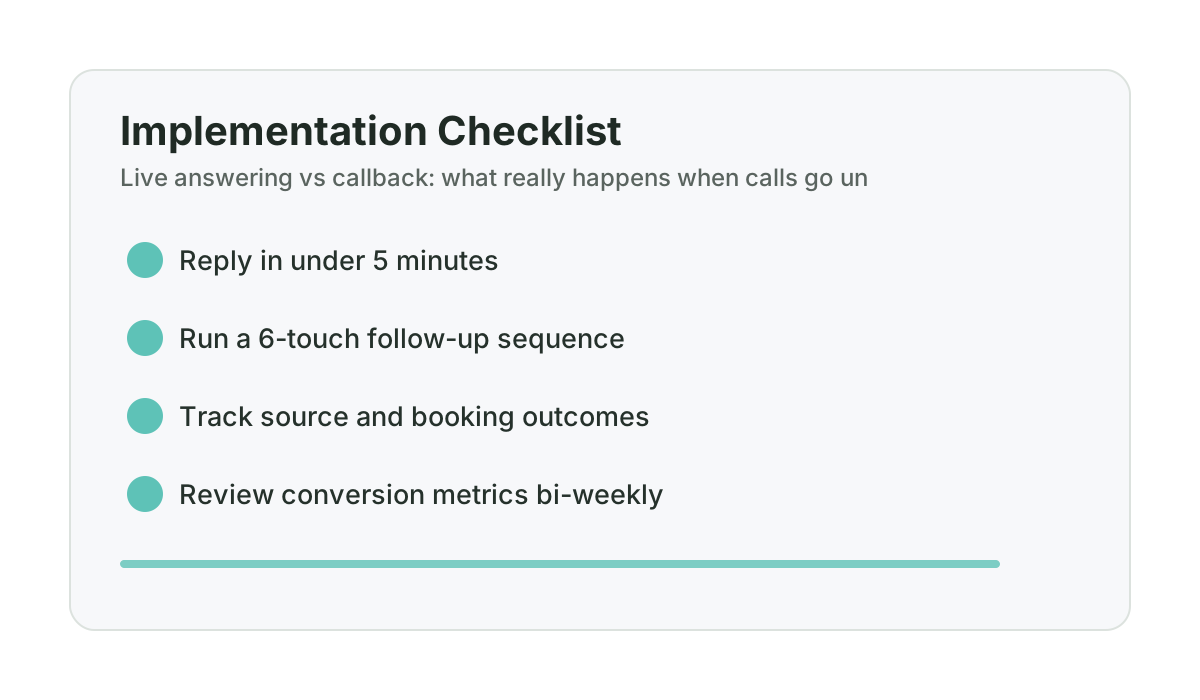
The problem: This works reasonably well during business hours if you’re disciplined. It completely breaks down after hours and on weekends. It also depends on the caller still being available when you call back — which is not certain even 30 minutes later. Lead response research has repeatedly shown that contact probability drops as delay increases. Source: Harvard Business Review summary of MIT lead response research If you want to make manual callbacks more effective, a speed-to-lead SOP can help your team hit faster response windows consistently.
How much revenue are you losing after 5 PM?
Calculate the actual dollar amount walking out the door every evening and weekend. Takes 2 minutes with your real numbers.
Run the numbers for your business: Calculate your after-hours leak. It takes 2-3 minutes and gives you a clear baseline before your next estimate round.
Option 4: Auto-text on missed call
When a call goes unanswered, an automated SMS is sent to the caller within seconds during legally permitted messaging hours, with restricted-hour inquiries queued for the next compliant window. The message acknowledges the missed call and invites a text conversation.
Lead capture rate: 35–50%
Cost: $50–$200/month depending on platform and volume
Why it works better: SMS is usually read faster than email in homeowner communication workflows, which makes it useful for fast acknowledgment and next-step coordination. A homeowner who just called you is already holding their phone. A fast text response during permitted messaging windows can catch them before they dial the next contractor. Even a basic “Hi, I missed your call — what can I help you with?” opens a conversation. The two-text missed call recovery playbook breaks down exactly what those messages should say.
The limitation: The auto-text opens the conversation, but now someone needs to respond to it. If you’re on a job site and can’t respond for two hours, the conversation goes cold. The missed call text-back solves the first 60 seconds. It doesn’t solve the next two hours.
Option 5: Live answering service
A third-party service staffed by humans answers your calls when you’re unavailable, takes a message, and notifies you.
Lead capture rate: 40–55% (better than voicemail, still requires your follow-up)
Cost: $200–$600/month for a basic service; per-minute billing often adds up faster than expected
Why contractors try this: It sounds professional. A human answers. The caller feels heard.
Why it often disappoints: Live answering services take messages — they don’t book estimates. The homeowner is told someone will call them back. You receive an email with their name and number. You still need to make the return call. And the receptionist who answered your call knows nothing about renovation — they can’t answer questions about your process, your service area, or your typical project timeline. They’re a message relay, not a conversion system.
The per-minute billing problem: Many services charge per minute of call time. A qualifying conversation with a homeowner about their basement renovation project can run 8–12 minutes. At $1.50–$2.00/minute, that’s $12–$24 per call — before you’ve won anything. Volume-based businesses find this cost structure difficult to control.
Option 6: AI response system
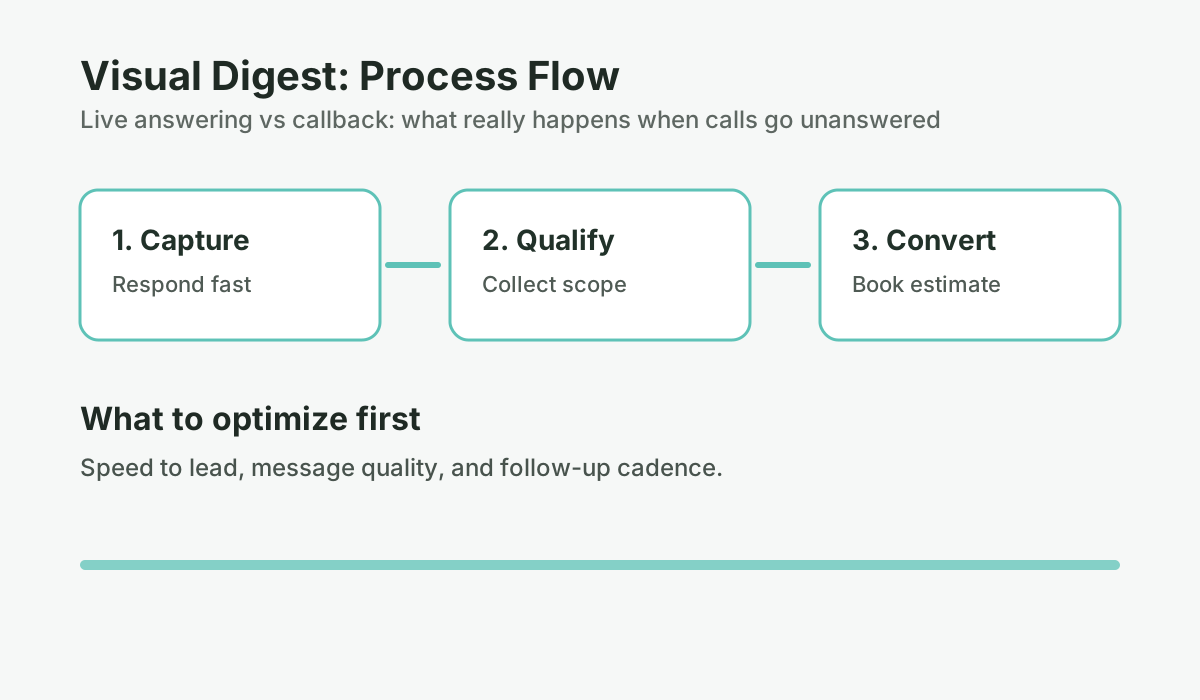
An AI conversation agent responds to every missed call (via text), web form submission, or direct message within seconds during legally permitted messaging hours, with restricted-hour inquiries queued for the next compliant window. It holds a real qualifying conversation, answers questions about your business, and books estimate appointments directly.
Lead capture rate: 60–80% (of reachable leads)
Cost: $500–$1,500/month for a managed service; DIY platforms exist but require substantial setup
Why it outperforms the alternatives: Speed and coverage. The AI monitors inquiries around the clock, responds within seconds during legally permitted messaging hours, and queues restricted-hour inquiries for the next compliant window. It can handle multiple simultaneous conversations. And unlike a live answering service, it actually moves the conversation toward a booked estimate — not just a message taken.
The key distinction: AI systems like ConversionSurgery’s managed setup are not chatbots with pre-written responses. They’re goal-oriented conversation agents that understand your business, your services, your service area, and your process. They ask qualifying questions. They handle objections. They book appointments.
Contractor answering service comparison: all six options side by side
A contractor answering service comparison evaluates the lead capture rate, cost, and conversion capability of each response method available when a contractor’s phone goes unanswered — from voicemail to AI-powered systems.
| Option | Lead Capture Rate | Monthly Cost | After-Hours Coverage | Books Estimates | Qualifies Leads |
|---|---|---|---|---|---|
| Do nothing | 10–15% | $0 | None | No | No |
| Voicemail only | 15–20% | ~$0 | Partial (message left) | No | No |
| Manual callback | 25–40% | $0–$500 (staff time) | No | Rarely | Partially |
| Auto-text on missed call | 35–50% | $50–$200 | Partial (opens conversation) | No | No |
| Live answering service | 40–55% | $200–$600+ | Yes (if on a plan with compliant after-hours coverage) | No | No |
| AI response system | 60–80% | $500–$1,500 | Yes (with around-the-clock monitoring, legally compliant response windows, and restricted-hour queueing) | Yes | Yes |
All capture rates in this article are directional planning assumptions. Replace them with your own call tracking, form logs, and close-rate data before making budget decisions.
What does each option actually cost per captured lead?
The monthly cost numbers above can be misleading without context. The right question isn’t “what does each option cost per month” — it’s “what does each option cost per captured lead, and what’s the value of the leads it misses.”
Let’s use a concrete example. A contractor receives 40 calls per month. Half are during business hours, half are after hours or weekends.
- Voicemail only: Captures ~6–8 leads ($0/month). Loses ~32–34 leads. At a 25% close rate on $45K average project: ~$360,000–$382,500 in missed pipeline per month across those lost leads.
- Live answering service: Captures ~16–22 leads ($400/month). Still loses 18–24 leads. Improvement, but still substantial leakage — and the captured leads still need your follow-up call.
- AI response system: Captures ~24–32 leads ($1,000/month). Misses ~8–16 leads (those who don’t respond to texts). Pipeline recovered: meaningful. Estimates already booked when you arrive Monday morning.
The math on recovering even a few additional leads per month can justify the cost quickly when recovered-lead volume is consistent. A single recovered basement renovation at $55K can cover a large portion of annual system cost at this price point. For the full breakdown of how one recovered project pays for the entire system, the ROI math becomes clearer when you run it against your own baseline.
What I actually recommend
The answer depends on your current situation. Here’s the honest version:
If you’re under $500K revenue and just starting to think about this: set up a missed call auto-text at minimum. It’s cheap, takes an afternoon to configure, and will capture some leads that would otherwise walk. Accept that you’ll have gaps, and plan to upgrade as volume justifies it.
If you’re doing $500K–$3M with 15–80 leads per month: run the math with your own numbers. The service cost is $997/month, and renovation ticket sizes are often high enough that recovering even a small number of otherwise-lost opportunities can cover cost. Use a conservative model first, then adjust after 30 days of live data.
If you’re already using a live answering service: it’s not a complete solution. You’re still losing after-hours leads who don’t get a response fast enough, and you’re paying per-minute for conversations that don’t result in booked estimates. Compare your current monthly cost against an AI system and calculate how many additional leads you’d need to capture to justify the switch.
The ConversionSurgery Revenue Recovery System handles missed calls, web forms, and direct messages — with around-the-clock monitoring, responses within seconds during legally permitted messaging hours, restricted-hour inquiries queued for the next compliant window, and managed service so there’s nothing for you to set up or maintain. If you don’t see at least 5 Qualified Lead Engagements in 30 days, the first month is refunded under the 30-day Proof-of-Life guarantee.
Frequently asked questions
What is the difference between a live answering service and an AI answering system for contractors?
A live answering service uses human receptionists to answer calls, take a message, and relay it to you. They typically cannot book appointments, answer specific questions about your services, or qualify the project — they’re message takers. An AI answering system responds within seconds during legally permitted messaging hours, queues restricted-hour inquiries for the next compliant window, holds a real qualifying conversation, answers questions about your business, and books estimate appointments directly into your calendar. The AI system also operates with around-the-clock monitoring at a flat rate, while live answering services often charge per minute, making cost less predictable at scale.
How many contractor calls actually go unanswered?
The exact unanswered-call rate varies by company, but most owner-operator teams discover meaningful call leakage when they audit 30 days of logs. If callers regularly hit voicemail and do not reconnect quickly, treat that as a workflow issue to fix quickly.
Does a missed call text-back service actually work for contractors?
A missed call text-back service opens a conversation with a homeowner who just called you — and that alone is more than most contractors do. It catches the homeowner while they’re still holding their phone, before they dial a competitor. However, a simple auto-text only opens the conversation. If no one follows up promptly within that text thread, the lead still goes cold. It works best as part of a system where the AI or a staff member can actually continue the conversation and move toward booking an estimate.
What is the average cost of a contractor answering service?
Live answering service pricing and minute-based fees vary materially by provider and contract terms, so verify current rates directly with vendors before comparing. For a fair decision, compare total monthly cost, hours covered, booking capability, and whether missed-call recovery is included.
Current guarantee structure: 30-day Proof-of-Life (5 Qualified Lead Engagements) plus a 90-day Revenue Recovery guarantee tied to at least one attributed project opportunity.
Want help applying this to your pipeline?
Use the matching diagnostic tool first, then book a quick strategy call if you want a done-for-you rollout.

Mashrur Rahman
Founder, ConversionSurgery
I build revenue recovery systems for renovation contractors. After seeing how much money remodelers lose to slow follow-up and missed calls, I built a managed service that handles lead response, estimate follow-up, and after-hours capture automatically. The data in these articles comes from running these systems across real contracting businesses.
Related reading
Personal cell to dedicated business number: migration playbook for contractors
A low-risk migration framework for contractors moving from personal phone lead handling to a proper business communication system.
Edmonton contractors: how to stop losing weekend renovation leads
A city-specific weekend lead capture system for Edmonton renovation contractors who lose inquiries between Friday night and Monday morning.
After-hours coverage ROI: when to add coverage vs adjust your ad schedule
Before spending $997/month on after-hours coverage — or cutting weekend ad spend — run this ROI framework with your own numbers first.