One project pays for everything: the ROI of faster lead response
Updated
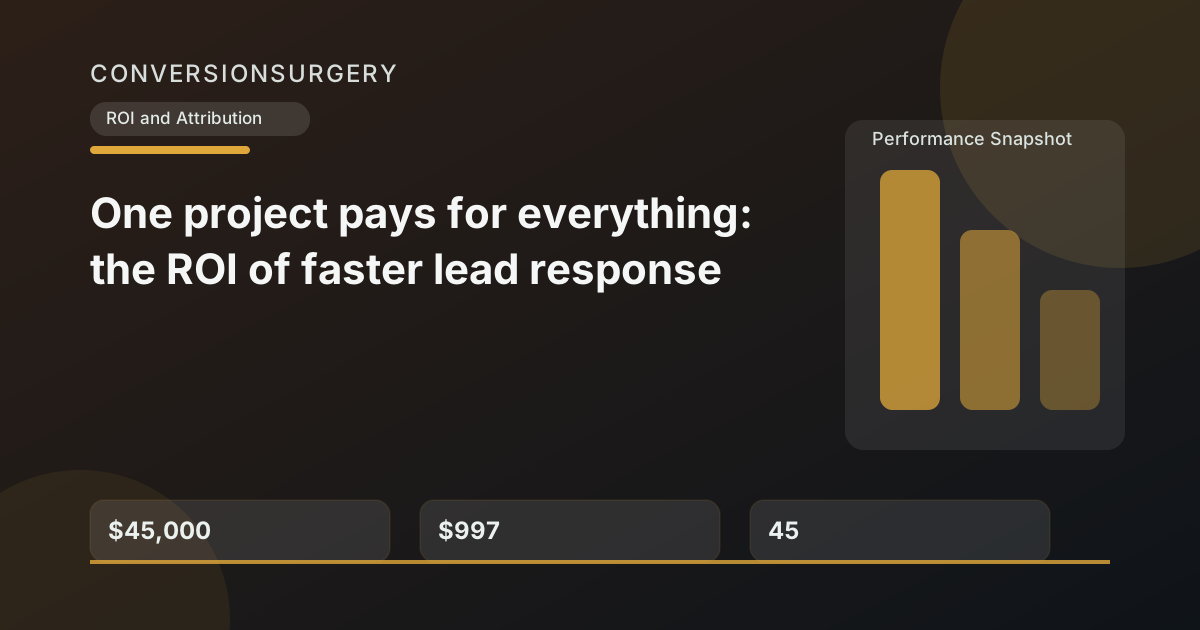
The ROI of faster lead response for contractors is straightforward: a single recovered $45,000 kitchen project at a $997/month investment pays for nearly 45 months of service — almost four years. That’s the break-even math before accounting for every additional job you recover after that. If your average project is anywhere between $30,000 and $65,000, one lead you would have otherwise lost justifies the entire cost of a follow-up system for multiple years. The question isn’t whether the ROI is there. It’s how many projects you’re currently losing that you don’t know about.
Key takeaways
- One recovered $45K kitchen job pays for nearly 4 years of a $997/month follow-up system — additional wins beyond that improve ROI further.
- Contractors who respond within 5 minutes are 21x more likely to qualify a lead than those who wait 30 minutes — response speed is the single largest variable in winning jobs.
- Even conservative estimates show contractors losing $432,000+ per year to slow response, while a follow-up system can produce strong ROI when fit conditions and execution quality are in place.
- The structural problem is real: you cannot answer the phone while on a job site, and the math inflection point hits between $800K and $1.5M in annual revenue.
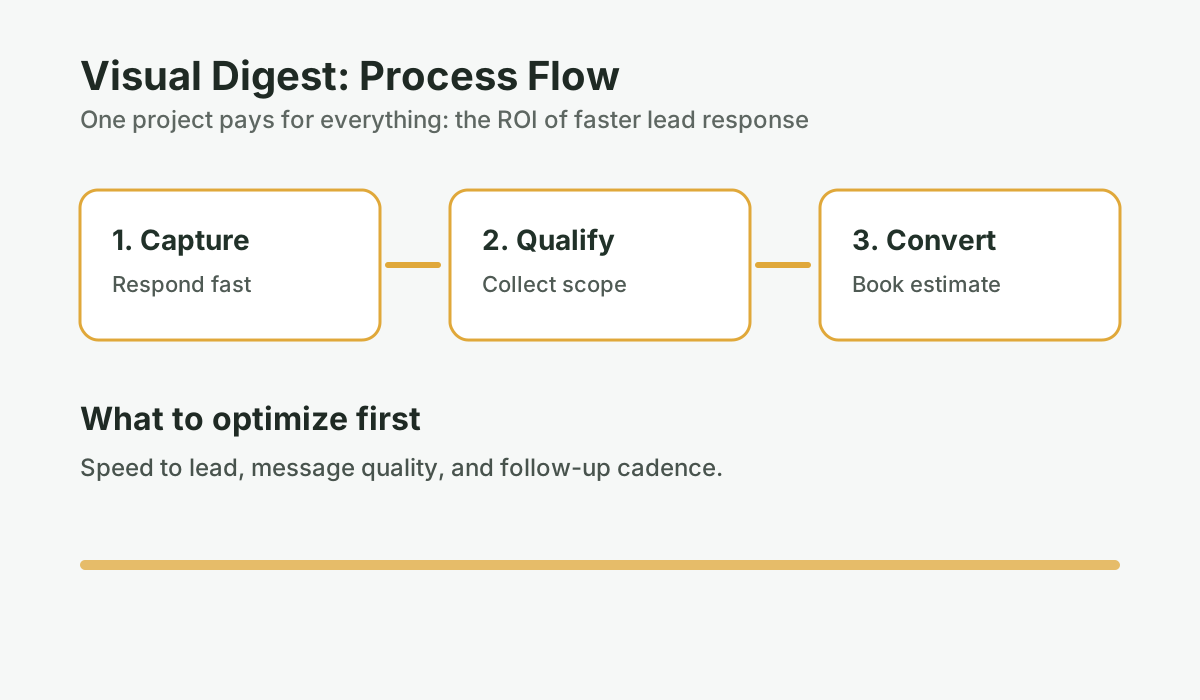
How do you measure the revenue leak from slow lead response?
A revenue leak is the gap between the inquiries a contractor receives and the jobs they actually close — specifically the revenue lost because leads went unanswered, were responded to too slowly, or did not receive follow-up.
Most contractors know they’re losing some leads. What they don’t know is how many, and what that actually costs them per year in unrealized revenue.
A useful formula to make this concrete is:
Revenue Leak = Missed or Slow Leads × Average Project Value × Expected Close Rate
Run those numbers against a real contractor profile and the result is uncomfortable. Say you’re getting 40 inquiries per month. Industry data suggests 40–60% of calls go unanswered by contractors on job sites. Source: Invoca State of the Phone Call report, 2023 So conservatively, 16 of those 40 inquiries either don’t get answered or wait more than 42 minutes for a response — which industry surveys suggest is close to the average response time for contractors. Source: industry response time benchmarks; Velocify Lead Response Management Study
Now apply a 25% expected close rate against those 16 slow or missed leads. That’s four jobs per month you should be closing but aren’t. At $45,000 average project value, that’s $180,000 per month in potential revenue that does not materialize. Per year: $2.16 million.
That is a dramatic number. Most of those leads would have gone to you anyway if you’d responded faster, and not every slow response means a lost job. But even if you accept that you’re recovering 80% of them naturally, the residual leak — the 20% you genuinely lose to competitors who picked up the phone first — still costs you $432,000 per year in that scenario. If you want to understand how response delays create this problem in the first place, the 42-minute problem explains why renovation leads go cold so fast.
The point isn’t to scare you. It’s to make the math visible so you can make a rational decision about whether fixing it is worth $997 per month.
Why is response time the largest variable in contractor follow-up ROI?
The research on this is consistent and has held up across multiple studies and industries. When a homeowner submits a quote request or makes an inquiry, the contractor who responds first wins the job at a dramatically higher rate than those who respond later.
MIT research found that leads contacted within 5 minutes are 100 times more likely to connect and 21 times more likely to qualify than leads contacted after 30 minutes. Source: MIT Lead Response Management Study, James Oldroyd et al., 2011
In home services specifically, first-to-respond wins 35–50% of available jobs. Source: ServiceTitan Contractor Benchmark Report, 2022 The second and third callers split what’s left — and if they called within minutes instead of hours, they take most of it.
This dynamic is more pronounced in renovation than in most other trades. A homeowner looking for a plumber to fix an emergency has urgency driving them — they’ll call multiple contractors simultaneously and take whoever shows up first. A homeowner planning a kitchen renovation is comparison shopping. They submit three or four requests, wait to see who responds, and their first impression of each contractor starts from the moment of inquiry. If you respond in 45 minutes and your competitor has a system that responds within seconds during legally permitted messaging hours, with restricted-hour inquiries queued for the next compliant window, the homeowner has often formed an opinion before they’ve spoken to either of you.
| Response Time | Relative Likelihood of Connecting | Relative Likelihood of Qualifying | Practical Impact |
|---|---|---|---|
| Under 1 minute | Baseline | Baseline | Highest win rate |
| 1–5 minutes | Roughly equivalent | Roughly equivalent | Still competitive |
| 5–30 minutes | Declining sharply | Declining sharply | Homeowner likely talking to a competitor |
| 30–60 minutes | Significantly reduced | 21x lower than 5-min response | Decision likely already influenced |
| Over 1 hour | Near bottom | Near bottom | Often too late |
Source: MIT Lead Response Management Study, James Oldroyd et al., 2011; Velocify Lead Response Management Study
The structural problem: you can’t respond fast when you’re on a job
Here’s the reality of running a renovation business. When you’re mid-install on a kitchen or supervising a basement pour, your phone is either off or going to voicemail. This isn’t a character flaw — it’s physics. You cannot be two places at once.
A common pattern:
- Inquiry comes in at 2:15 PM while you’re on a job site
- You see the missed call at 5:30 PM on your drive home
- You mean to call back after dinner, but it slips
- By 9 AM the next morning when you remember, the homeowner has already booked an estimate with the contractor who texted them back at 2:17 PM
This happens not because you’re careless but because you’re busy doing the work. The problem is structural. A busy contractor is often a successful contractor — until the volume of missed leads starts costing more than the current jobs are generating. Even a simple two-text missed call recovery playbook can recapture leads that would otherwise disappear while you’re on site.
The math inflection point is usually somewhere between $800K and $1.5M in annual revenue. At that size, you’re getting enough inquiries that the leak is material, but you don’t yet have dedicated office staff managing every inbound contact.
What would fixing your follow-up gaps actually be worth?
Three inputs from your business. One formula. A clear picture of the revenue you could recover this year.
Run the numbers for your business: Run the Revenue Leak Scorecard. It takes 2-3 minutes and gives you a clear baseline before your next estimate round.
How to run the break-even calculation for your own business
Break-even on a follow-up system means the point at which recovered revenue from previously lost leads equals the total cost of the system — calculated by dividing your average project value by the monthly system cost.
The formula is simple enough to run in your head. Take your average project value and divide it by $997 per month.
Average project value of $30,000: 30 months of service paid for by one recovered job.
Average project value of $45,000: 45 months — nearly four years.
Average project value of $65,000: 65 months — over five years.
Now consider close rate improvement. This is where the math gets more interesting. Using a modeled scenario with published benchmark ranges — 25 estimates per month, a close-rate move from 24% to 36%, and a $30,000 average project value — the implied lift is three additional jobs per month, or about $90,000 in monthly signed-project value. This is an assumption-based model, not a guaranteed outcome.
It is important to be careful here. Not every contractor will see a 13-point close rate improvement. But moving from 25% to 31% — a more conservative six-point gain — on 25 estimates per month and $30,000 average project value still produces $45,000 per month in additional revenue. That’s a 45x return. For a structured approach to the follow-up that drives these close rate gains, see how a follow-up cadence revives estimates that go cold.
Modeled scenarios using published response-time and follow-up benchmarks indicate that moving close rates from the low-20% range into the low-30% range can add meaningful annual revenue from the same lead volume. Under those assumptions, the implied ROI on a $997/month investment can be strong.
What does faster response actually change in practice?
When every lead gets a response within seconds during legally permitted messaging hours, with restricted-hour inquiries queued for the next compliant window, a few things shift:
The comparison dynamic changes. Most homeowners contact three to five contractors. If you’re the one who responded while the others haven’t yet, you control the first conversation. You set the standard they compare everyone else against.
The estimate appointment is more likely to hold. A homeowner who received a fast, professional response and booked an estimate has a higher emotional investment in the process. They showed up to the appointment because the contractor felt reliable from the first contact.
Your close rate can improve before you’ve changed the estimate itself. The estimate quality may be unchanged. The difference is that you get to present it before the homeowner commits elsewhere, because the first meaningful response happened when messaging was legally permitted. For a real-world example of this dynamic, the research on what happens when a 9:47 PM lead gets a queued response at the next permitted window.
What is the real cost of doing nothing about response time?
Choosing not to address response time isn’t a neutral decision. If your current response time is around 42 minutes — close to what industry surveys suggest is the average — and you’re losing even two or three jobs per month to competitors who respond faster, the cost of inaction compounds every month.
Two jobs per month at $40,000 average project value: $80,000 per month, $960,000 per year in lost revenue.
Three jobs per month at $40,000: $120,000 per month, $1.44 million per year.
Set against a $997/month follow-up system, the modeled math is directionally strong when assumptions hold. The question is whether you believe you’re actually losing jobs to response time — and if you’re honest about the times your phone goes unanswered during the workday, you probably already know the answer.
A single recovered $45,000 kitchen job at $997/month covers 45 months of service. That’s the baseline break-even. Additional wins beyond that represent incremental recovered revenue that was previously being missed.
Frequently asked questions
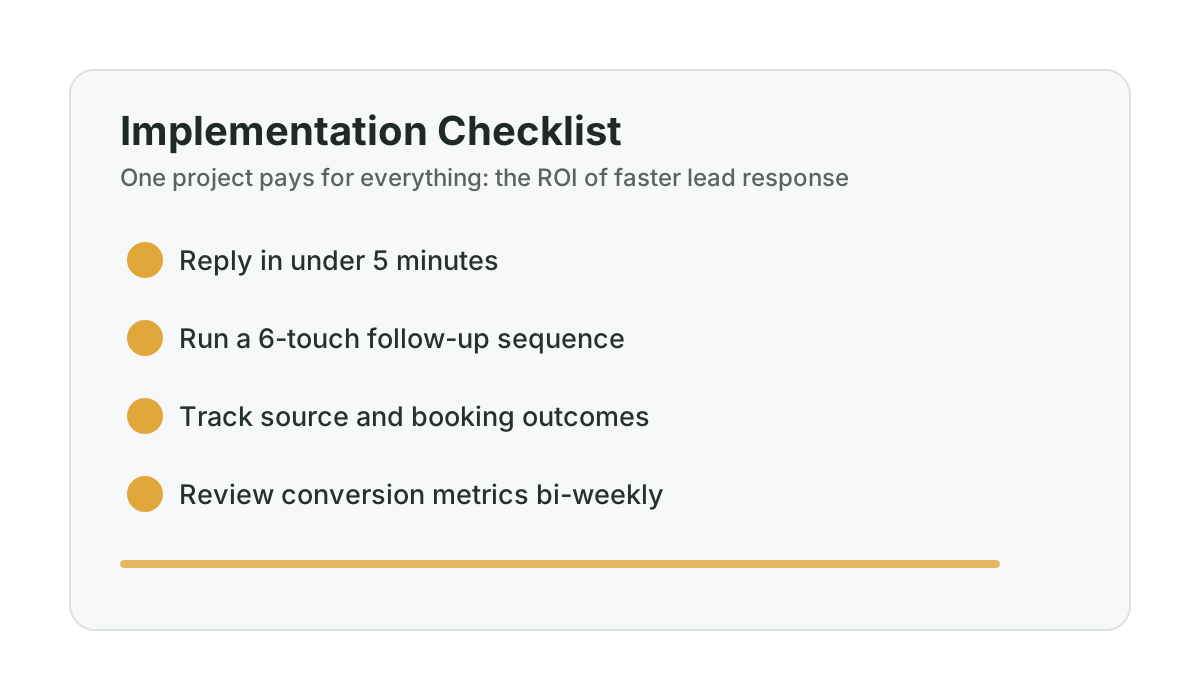
How do I calculate contractor follow-up ROI for my specific business?
Use this formula: Revenue Leak = Missed or Slow Leads × Average Project Value × Expected Close Rate. Start with your monthly inquiry volume, apply the 40–60% industry miss rate to estimate how many aren’t getting fast responses, then multiply by your average project value and your current close rate. That gives you the annual revenue you’re likely losing. Compare that against the monthly cost of a follow-up system to get your ROI multiple.
What counts as a “fast enough” response for renovation leads?
The MIT Lead Response Management Study established that the meaningful threshold is 5 minutes. Leads contacted within 5 minutes are 21 times more likely to qualify than those contacted after 30 minutes. In practice, under 1 minute is ideal. Industry surveys suggest the average contractor response time is around 42 minutes, which means responding in under 5 minutes already puts you ahead of most competitors.
Does faster response really improve close rates, or just inquiry-to-estimate conversion?
Both. Faster response increases the percentage of inquiries that convert to estimate appointments — because the homeowner hasn’t yet committed to a competitor. It also improves close rates because homeowners who received a fast, professional first response are more likely to show up to the estimate and have a more positive baseline impression going in.
What if I respond fast but still don’t close more jobs?
Faster response improves your chances, but it doesn’t replace a good estimate process or competitive pricing. If you’re responding quickly and still not converting, the bottleneck has moved downstream — usually to estimate follow-up. Most contractors lose jobs in the 48–96 hours after sending an estimate when the homeowner is comparing options and no one is following up.
Is $997/month a reasonable investment for a contractor doing under $1M in revenue?
The relevant question is how many projects you’re losing per month to slow response and missed follow-up. At an average project value of $30,000, recovering one additional job per month produces $360,000 in annual revenue against a $11,964/year system cost. That’s roughly 30x. If you’re genuinely getting 15 or more inquiries per month and have a 25%+ close rate, the math often works. The floor for it making sense is roughly $500K in annual revenue with consistent inbound lead flow.
Want help applying this to your pipeline?
Use the matching diagnostic tool first, then book a quick strategy call if you want a done-for-you rollout.

Mashrur Rahman
Founder, ConversionSurgery
I build revenue recovery systems for renovation contractors. After seeing how much money remodelers lose to slow follow-up and missed calls, I built a managed service that handles lead response, estimate follow-up, and after-hours capture automatically. The data in these articles comes from running these systems across real contracting businesses.
Related reading
Deposit and invoice reminder system for contractors: improve cash flow without awkward chasing
A practical automation framework for deposit and invoice reminders that improves payment speed and reduces owner stress.
The $997 vs hiring debate: cost comparison for lead coverage and follow-up
An office admin costs $50K+/year. A VA runs $2K–$3K/month. An answering service $250–$500/month. Honest cost comparison for every option.
Marketing ROI without guesswork: from lead to booked estimate to closed job
Most contractors track spend and jobs won. Inquiry to estimate to close is where visibility disappears and money leaks. Here’s what to measure.