Marketing ROI without guesswork: from lead to booked estimate to closed job
Updated
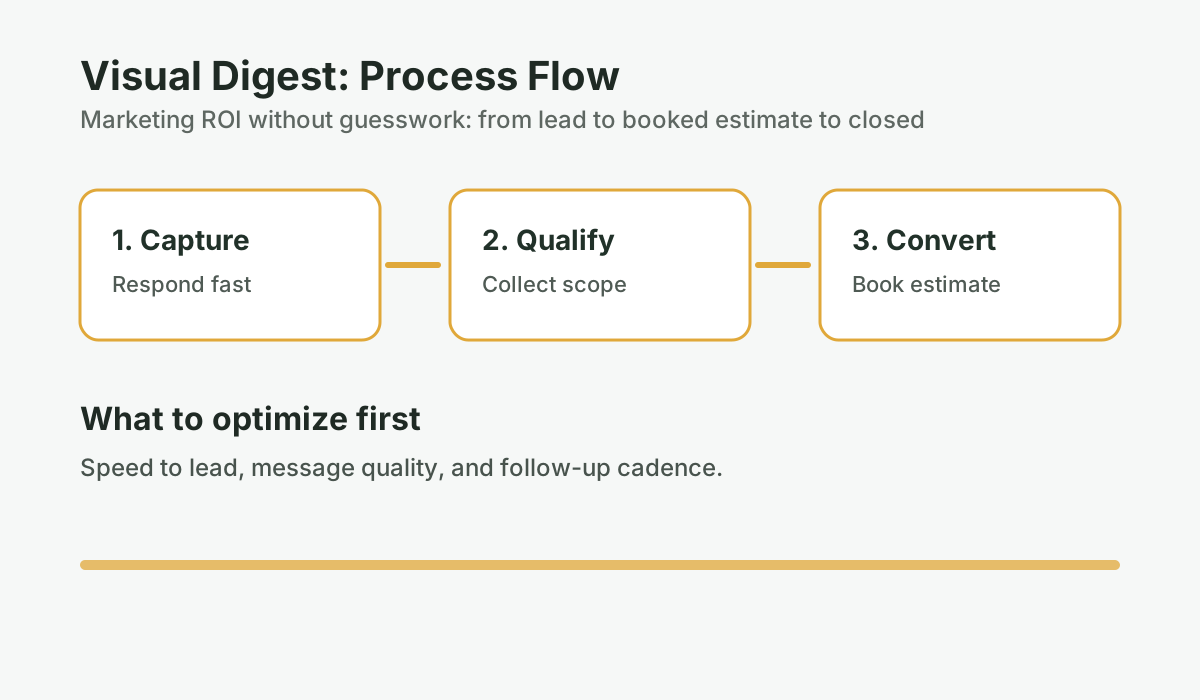
Contractor marketing ROI tracking commonly fails at the same point for remodelers: between the lead and the closed job. They know roughly what they spend on Google Ads or lead gen platforms. They know what revenue they brought in. But what happened in between — how many inquiries became estimate appointments, how many estimates were actually sent, how many followed up, how many closed — is usually a blank. Without that middle visibility, you can’t calculate true marketing ROI, you can’t identify where you’re losing jobs, and you can’t make rational decisions about where to invest more or less. This post gives you a simple tracking framework that covers every stage from first inquiry to closed job.
Key takeaways
- Most contractors only track marketing spend and closed jobs — the 3 conversion stages in between (contact rate, estimate booking, show rate) are where the real revenue leaks hide.
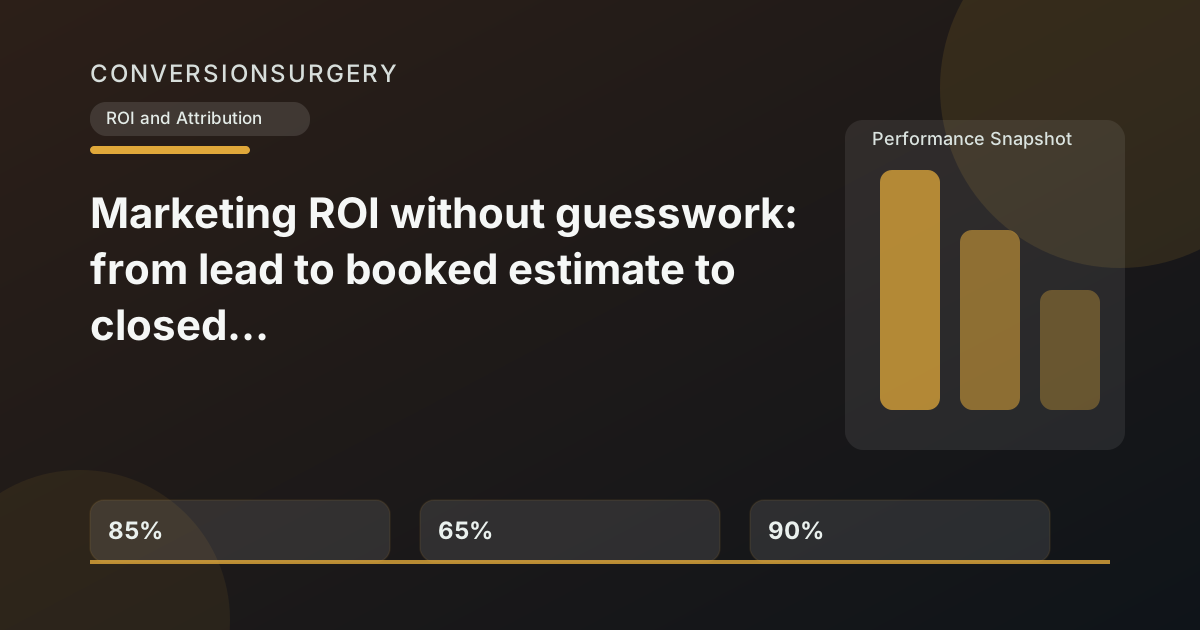
- Track your 5-stage renovation sales funnel: inquiry volume, contact rate (target 85%+), estimate booking rate (target 65%+), show rate (target 90%+), and close rate (target 30%+).
- Improving your conversion funnel is often higher ROI than increasing ad spend — fixing a 50% contact rate to 80% can double your closed jobs from the same marketing budget.
- You can start tracking all 5 stages this week with a simple spreadsheet — no CRM required. Five minutes per evening is enough.
- The gap between perceived and actual response time is where most revenue leaks live: contractors who think they respond in 10–15 minutes are usually averaging 40–60 minutes.
Why are most contractors’ marketing ROI numbers misleading?
There are two common approaches to measuring marketing ROI in contracting, and both are incomplete.
The first is revenue-over-spend: divide total revenue by total marketing spend and call it ROI. This tells you nothing actionable. If your close rate improves, your ROI goes up even if your marketing didn’t change. If your lead quality drops, ROI goes down even if your spend was well-allocated.
The second is tracking jobs from specific campaigns: “we ran a flyer campaign last month and got three calls.” Better, but still missing the conversion funnel. Three calls might mean three booked estimates, or three voicemails you returned the next day, or two conversations and one no-show to the estimate.
The only number that actually tells you where the money is going and where it’s being lost is the stage-by-stage conversion rate across the full funnel from first contact to signed contract.
What are the five stages of contractor marketing ROI tracking?
The contractor sales funnel has five measurable stages — inquiry, contact, estimate booked, estimate completed, and close — and tracking conversion rates between each stage reveals exactly where jobs are being lost and where investment will have the highest return.
Here are the five stages most renovation contractors move a prospect through, and what you should be measuring at each one.
Stage 1: Inquiry — how many contacts came in?
This is every phone call, web form submission, email, and social media message where a homeowner expressed interest in your services. Count all of them, including missed calls and unanswered voicemails.
Most contractors undercount at this stage because they don’t track missed calls and don’t have a system that captures all contact channels in one place. If you’re running Google Ads, your calls are logged in the platform. But your Google Business Profile calls, website form submissions, and Instagram DMs may not be going anywhere.
What to measure: Total inquiries per month, by source (Google Ads, organic search, referral, GBP, social, other).
Stage 2: Contact rate — how many did you actually reach?
Of all the inquiries you received, how many turned into a live conversation within a reasonable timeframe? This is where the first major leak happens for most contractors.
Industry data shows that 40–60% of contractor calls go unanswered during business hours. Source: Invoca State of the Phone Call Report, 2023 First-to-respond wins 35–50% of home service jobs. Source: ServiceTitan Contractor Benchmark Report, 2022 A contact rate below 70–75% is a flag that your response system needs attention before anything else does. If your contact rate is suffering because of response delays, building a speed-to-lead SOP is the most direct fix.
What to measure: Contact rate = live conversations ÷ total inquiries. Benchmark: aim for 85%+.
Stage 3: Estimate booked — how many contacts became estimate appointments?
Of the leads you actually spoke to or texted with, how many scheduled an estimate visit? This stage is influenced by your qualification process (are you talking to the right people?), your follow-up speed, and the quality of the first conversation.
A typical estimate booking rate after live contact is 40–60% for renovation contractors with no formal follow-up system, and 60–80% for those with a structured nurture sequence. Source: Velocify Lead Management Research, 2019; industry practitioner benchmarks
What to measure: Estimate booking rate = estimate appointments scheduled ÷ live contacts made. Benchmark: aim for 65%+.
Stage 4: Estimate completed — how many booked estimates actually happened?
No-shows are a significant drain on contractor time and morale. Industry data suggests 15–25% of estimate appointments result in no-shows when there’s no reminder system in place. Source: NARI (National Association of the Remodeling Industry) operational data; field observations from contractor benchmarking
Automated appointment reminders — a day before and a few hours before — reduce no-show rates to 5–8% in most implementations. That difference translates directly to more estimates actually delivered and more jobs available to close. A dedicated no-show reminder and reschedule system can recover most of the appointments that would otherwise disappear.
What to measure: Show rate = estimates completed ÷ estimates booked. Benchmark: aim for 90%+.
Stage 5: Close rate — how many estimates became signed jobs?
This is the most-tracked number, but also the most misleading in isolation. A close rate of 30% can mean very different things depending on everything upstream. A contractor with 90% contact rate, 75% estimate booking rate, 92% show rate, and 30% close rate has a fundamentally different business than one with 50% contact rate and 30% close rate — even though the final number is identical.
What to measure: Close rate = jobs won ÷ estimates sent. Industry range: 20–40% for renovation contractors. Benchmark: aim for 30%+.
| Stage | Metric | Formula | Industry Average | Target Benchmark |
|---|---|---|---|---|
| 1. Inquiry | Total inquiries | Count all contact channels | Varies by marketing spend | Track all sources |
| 2. Contact Rate | % of inquiries reached | Live contacts ÷ inquiries | 40–60% | 85%+ |
| 3. Estimate Booking | % of contacts that book | Estimates booked ÷ live contacts | 40–60% | 65%+ |
| 4. Show Rate | % of booked estimates that happen | Estimates completed ÷ booked | 75–85% | 90%+ |
| 5. Close Rate | % of estimates that close | Jobs won ÷ estimates sent | 20–30% | 30%+ |
Source: ServiceTitan Benchmark Report 2022; Invoca State of the Phone Call 2023; NARI industry data; Velocify Lead Management Research
Where do most contractors lose visibility — and revenue?
In my experience with renovation contractors, the visibility gap often appears between stages 1 and 2 — between inquiry and live contact. This is where the data stops being tracked and where the intuition-based assumption takes over: “we respond to everything pretty quickly.”
The assumption is usually wrong. Most contractors who actually audit their response time — checking their missed call log, their email response timestamps, their web form inquiry-to-response gap — discover they’re running a 40–60 minute average response time. They thought they were at 10–15 minutes. The gap between perceived and actual response time is where the revenue leak lives.
The second visibility gap is between stages 4 and 5 — estimates sent and follow-up activity. Most contractors send an estimate and then move on. They might follow up once. The homeowner says “let me think about it” and the contractor mentally moves that lead to the lost column. But industry research shows that 80% of sales require five or more follow-up contacts, while 44% of salespeople give up after one follow-up. Source: widely cited sales industry research; Hubspot Sales Statistics, 2023 In renovation specifically, where project decisions involve significant financial and lifestyle disruption, the average decision window is two to eight weeks. Stopping follow-up after one or two touches means abandoning the majority of leads during the window when they’re still deciding.
What would fixing your follow-up gaps actually be worth?
Three inputs from your business. One formula. A clear picture of the revenue you could recover this year.
Run the numbers for your business: Run the Revenue Leak Scorecard. It takes 2-3 minutes and gives you a clear baseline before your next estimate round.
How to set up a simple tracking system without buying software
You don’t need a CRM to start tracking this. Here’s a minimal system you can run in a spreadsheet:
Column headers: Date, Source (where they found you), Contact Info, Stage (Inquiry / Contacted / Estimate Booked / Estimate Done / Won / Lost), Project Type, Estimated Value, Notes, Date of Last Follow-Up, Next Follow-Up Date.
Update it every evening. Takes five minutes. After 30 days you’ll have enough data to calculate your actual conversion rate at each stage — not what you think it is, but what it actually is.
What you’ll likely find:
- Your contact rate is lower than you thought
- Some inquiry sources have dramatically higher estimate booking rates than others
- Your close rate on estimates you follow up on is meaningfully higher than on those you don’t
- The leads that booked fastest are the ones that closed at highest rates
These insights change where you invest attention and money. If referral leads close at 45% and ad leads close at 20%, and your referral system is underinvested, that’s the highest-ROI improvement available to you — not more ad spend.
How to calculate the real marketing ROI for contractors
True contractor marketing ROI measures revenue generated from a specific marketing source minus all costs (ad spend, system costs, time), divided by total cost — calculated stage by stage through the full sales funnel rather than as a simple revenue-over-spend ratio.
Once you have funnel data, actual marketing ROI becomes calculable:
True Marketing ROI = (Revenue from tracked source − Cost of source − Allocated system cost) ÷ Cost of source × 100
Example: Your Google Ads campaign costs $2,000/month and drives 15 qualified inquiries. Your contact rate is 70% (10.5 contacts), estimate booking rate is 65% (6.8 estimates), show rate is 85% (5.8 estimates completed), close rate is 28% (1.6 jobs). Average project value: $38,000. Revenue from the campaign: $60,800. ROI: ($60,800 − $2,000) ÷ $2,000 × 100 = 2,940% — approximately 30x.
That number only holds if your contact rate, booking rate, and show rate are where you think they are. If your contact rate is actually 50% instead of 70%, you’ve converted 7.5 contacts instead of 10.5 — that’s three additional potential jobs you didn’t capture. At 1.6 jobs per cycle, a 40% contact rate improvement could double your revenue from the same ad spend. If you’re curious whether buying another lead tool is likely to fix this or just add complexity, this analysis of why another tool won’t fix lead leaks is worth reading before you invest.
This is the most important insight in contractor marketing ROI: improving your conversion funnel is often higher ROI than increasing your ad spend. Spend more to get more leads into a leaky funnel, and you get more leakage. Fix the funnel first.
Frequently asked questions
What should a contractor track to measure marketing ROI accurately?
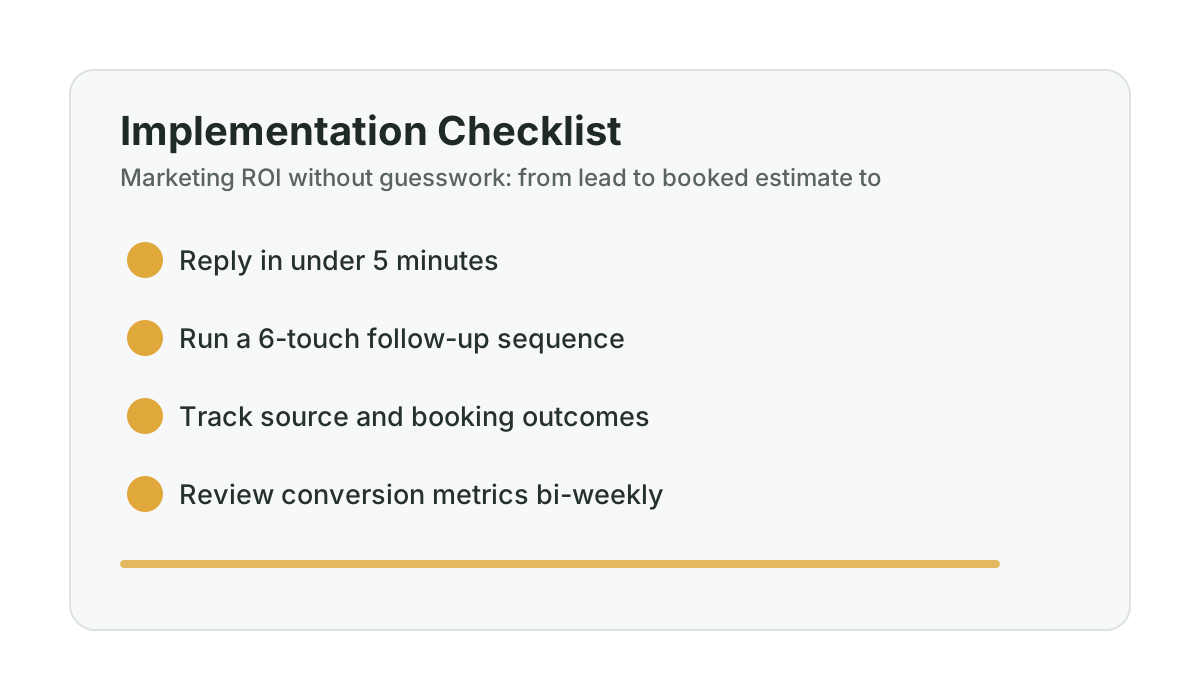
Track five metrics across the full sales funnel: total inquiries by source, contact rate (live conversations divided by inquiries), estimate booking rate (estimates scheduled divided by live contacts), show rate (estimates completed divided by booked), and close rate (jobs won divided by estimates sent). Tracking only spend and closed jobs misses the three conversion stages in between where most contractors lose visibility and revenue.
What is a good close rate for a renovation contractor?
The industry average close rate for renovation contractors is 20–30%. A well-run operation with consistent follow-up should be targeting 30–40%. The most significant driver of close rate improvement is systematic estimate follow-up — six to eight touches over six weeks — rather than anything about the estimate itself. Contractors who improve their follow-up process typically see measurable close rate improvements.
Where do most contractors lose jobs in the sales funnel?
Two primary points: between inquiry and live contact (due to missed calls and slow response — industry surveys suggest averages around 42 minutes), and between estimate sent and follow-up (most contractors follow up once or not at all, while research shows 80% of jobs require five or more follow-up contacts). Both of these are systems failures, not sales skill failures.
How do I calculate cost per closed job from my marketing spend?
Cost per closed job = Total marketing spend ÷ Jobs won from that spend. To calculate it correctly, you need to track which jobs came from which source. Use a dedicated phone number per campaign or ask every inbound caller how they found you. Referral and Google Business Profile leads typically have the lowest cost per closed job of any source — often under $500 — while paid ads range from $2,000 to $10,000+ depending on close rate and market competitiveness.
Should I invest in more leads or better conversion before scaling marketing spend?
Often, better conversion first. If your contact rate is 50% and your estimate booking rate is 45%, improving both to 80% and 65% respectively could more than double your closed jobs from the same marketing spend — without paying for a single additional lead. Only after your funnel conversion rates are optimized does it make sense to scale spend, because then each additional lead dollar produces a predictable return instead of disappearing into a leaky system.
Want help applying this to your pipeline?
Use the matching diagnostic tool first, then book a quick strategy call if you want a done-for-you rollout.

Mashrur Rahman
Founder, ConversionSurgery
I build revenue recovery systems for renovation contractors. After seeing how much money remodelers lose to slow follow-up and missed calls, I built a managed service that handles lead response, estimate follow-up, and after-hours capture automatically. The data in these articles comes from running these systems across real contracting businesses.
Related reading
Deposit and invoice reminder system for contractors: improve cash flow without awkward chasing
A practical automation framework for deposit and invoice reminders that improves payment speed and reduces owner stress.
The $997 vs hiring debate: cost comparison for lead coverage and follow-up
An office admin costs $50K+/year. A VA runs $2K–$3K/month. An answering service $250–$500/month. Honest cost comparison for every option.
What’s a lead worth in renovation? Valuing your pipeline using real project costs
A kitchen remodeling lead is worth $8K–$12K in expected revenue. Knowing your lead value changes how you make decisions about every inquiry you receive.