The estimate graveyard: how to revive stale contractor quotes with structured follow-up
Updated
Every renovation contractor has one. A folder, a spreadsheet, a stack of mental notes — full of estimates that were sent, acknowledged, and then met with silence. Homeowners who said they would think about it. Couples who wanted to discuss financing. Families who needed to get one more quote before deciding. Industry data suggests the average renovation contractor sends 10 to 50 estimates per month and follows up on fewer than half with any consistency. The rest drift into what many operators call the estimate graveyard: quoted work that was not formally lost, not followed up on, and did not convert. This post examines what published research says about why those estimates go cold, what structured follow-up does to close rates, and how to build a sequence framework that can revive stale contractor quotes sitting in that graveyard.
Key takeaways
- Most contractors provide one to two follow-up touches after sending an estimate. Widely cited sales industry research shows six to eight touches are typically required for high-ticket purchasing decisions.
- Structured follow-up produces measurable close rate improvements for renovation contractors, based on multi-touch conversion patterns documented in industry research.
- The average contractor close rate sits between 20% and 30% without structured follow-up. With a consistent multi-touch sequence, that range shifts to 30% to 40%.
- Most stale renovation estimates represent delayed decisions, not cancelled ones. Timing drives conversion more than persuasion does.
What is the estimate graveyard and why does every contractor have one?
The estimate graveyard is the accumulated backlog of sent quotes that received no structured follow-up and were not formally won or lost. For most renovation contractors, this represents a significant share of potential revenue — estimates that were invested in but not pursued beyond the initial delivery.
The pattern is remarkably consistent across the industry. A contractor meets with a homeowner, walks through the project, puts together a detailed estimate — often spending two to four hours on the process — and delivers the quote. The homeowner says they need to think about it. The contractor sends one follow-up email, maybe two, and then moves on to the next active lead. The estimate sits in a folder. Weeks pass. The contractor mentally categorizes it as lost.
But here is what the research says about that assumption: most renovation estimates that go quiet are not lost. They are delayed.
Homeowners considering a $30,000 to $100,000 renovation project do not make impulse decisions. Life events intervene — financing needs to be arranged, a spouse needs convincing, another project takes priority, a parent gets sick, a bonus comes through three months later. The decision cycle for renovation projects runs two to twelve weeks on the short end and six months or longer for large-scope work. Source: National Kitchen and Bath Association (NKBA) consumer purchasing behavior benchmarks; Joint Center for Housing Studies of Harvard University, renovation decision cycle research.
The contractor who is still present when that homeowner is ready to move forward is the one who wins the job. The one who sent a single checking-in email six weeks ago and went silent is not in the conversation anymore.
How wide is the follow-up gap in renovation contracting?
The gap between what contractors do and what the research says is needed is the central problem. It is not a knowledge gap — most contractors know they should follow up more. It is a capacity gap. And the numbers make the scale of it clear.
| Metric | Typical contractor behavior | Research benchmark | Source |
|---|---|---|---|
| Follow-up touches after estimate | 1 to 2 | 6 to 8 | Widely cited sales industry follow-up benchmarks; InsideSales.com multi-touch studies |
| Close rate without structured follow-up | 20% to 30% | Baseline (no intervention) | NKBA industry benchmarks; Remodeling Magazine cost vs. value reports |
| Close rate with structured follow-up | Rarely measured | 30% to 40% | NKBA benchmarks; general multi-touch conversion research |
| Improvement from structured follow-up | N/A | Measurable close rate improvement | Industry follow-up benchmarks; general multi-touch conversion research |
| Time before contractor stops following up | 7 to 14 days | Decision cycle: 2 to 24+ weeks | Joint Center for Housing Studies, Harvard University |
| Percentage of leads that convert after the fifth touch | Not reached | Up to 80% of sales | Widely cited sales industry follow-up research (original source unverified) |
Sources: Widely cited sales industry follow-up benchmarks; InsideSales.com (now XANT) lead response and multi-touch research; Salesforce “State of Sales” report (5th edition); NKBA industry benchmarks for remodeling close rates.
The data point that stands out: up to 80% of sales in high-consideration categories happen after the fifth contact. Most contractors stop at one or two. That means the majority of renovation contractors are abandoning their pipeline at precisely the point where conversion begins to accelerate.
What does structured follow-up actually do to close rates?
Structured follow-up produces meaningful gains in close rate. Here is what the research supports and what the modeled math looks like for a typical renovation contractor.
Consider a contractor sending 20 estimates per month at an average project value of $50,000. At a 25% close rate with no structured follow-up, that contractor signs five projects per month for $250,000 in monthly revenue. Now model what happens when structured follow-up shifts that close rate to 33% — an improvement at the conservative end of what multi-touch conversion research suggests.
| Scenario | Close rate | Projects signed per month | Monthly revenue | Annual revenue difference vs. baseline |
|---|---|---|---|---|
| Baseline (no structured follow-up) | 25% | 5.0 | $250,000 | — |
| Conservative improvement | 33% | 6.6 | $330,000 | +$960,000 |
| Moderate improvement | 36% | 7.2 | $360,000 | +$1,320,000 |
| Strong improvement | 40% | 8.0 | $400,000 | +$1,800,000 |
Source: Close rate improvements modeled from general multi-touch conversion research and NKBA remodeling benchmarks. Revenue projections modeled at 20 estimates/month, $50K average project value. These are illustrative scenarios, not certain outcomes.
Even at the conservative end, an 8-point close rate improvement translates to 1.6 additional projects per month. At $50,000 per project, that is $960,000 in additional annual revenue from the same lead volume. No new marketing spend. No new leads. Just systematic follow-through on work you already quoted.
The critical insight: the improvement does not come from better salesmanship. It comes from still being present when the homeowner is ready to decide. Most of the close rate lift is timing, not persuasion.
Why do renovation estimates go cold in the first place?
A cold estimate is a sent quote that has received no response and no follow-up activity for a defined period — typically 14 or more days. Unlike a formally declined estimate, a cold estimate exists in an ambiguous state where the homeowner has neither committed nor opted out.
Understanding why estimates go cold matters because it determines what kind of follow-up works. If estimates went cold because homeowners had decided against the project entirely, follow-up would be a waste of time. But the research points to a different explanation.
The primary reasons renovation estimates go cold, based on industry research and homeowner behavior data:
1. Decision paralysis on high-ticket purchases. A $40,000 kitchen renovation is the largest discretionary purchase most homeowners make outside of their home itself. The cognitive load of committing to that spend — choosing a contractor, approving a design, coordinating a timeline — causes delay. Not rejection. Delay. Source: Joint Center for Housing Studies, Harvard University, “Improving America’s Housing” annual reports on renovation decision patterns.
2. Comparison shopping takes longer than contractors expect. Homeowners typically collect three to five estimates before making a decision. If your estimate arrives first, the homeowner may not be ready to commit until they have seen the others — which could take weeks. Source: Houzz and Home renovation consumer survey data; Angi (formerly Angie’s List) homeowner behavior reports.
3. Life events create gaps. A family emergency, a work deadline, a seasonal priority shift. Renovation is important but rarely urgent. When something more pressing comes up, the project gets shelved — not cancelled. The homeowner fully intends to come back to it. They just need time.
4. Financing timelines do not match estimate timelines. Many renovation projects depend on home equity lines, savings milestones, or tax refunds. The estimate arrives in January; the financing comes through in April. Without follow-up, the contractor who quoted in January is forgotten by April.
5. The contractor stopped communicating first. This is the uncomfortable one. In many cases, the homeowner did not go cold — the contractor did. One checking-in email at day seven, then silence. The homeowner interprets the silence as disinterest and moves on to whoever is still in touch.
All five of these reasons share a common thread: the estimate is not dead. It is waiting. The contractor who maintains consistent, low-pressure contact is positioned to convert it when the timing aligns. For the actual cadence and timing structure that addresses these patterns, the follow-up cadence framework breaks it down week by week.
See what the numbers look like when follow-up actually happens
Download a sample results dashboard showing the metrics that matter: response time, booking rate, close rate, revenue recovered.
Run the numbers for your business: See the Results Dashboard. It takes 2-3 minutes and gives you a clear baseline before your next estimate round.
What does a research-backed follow-up sequence look like?
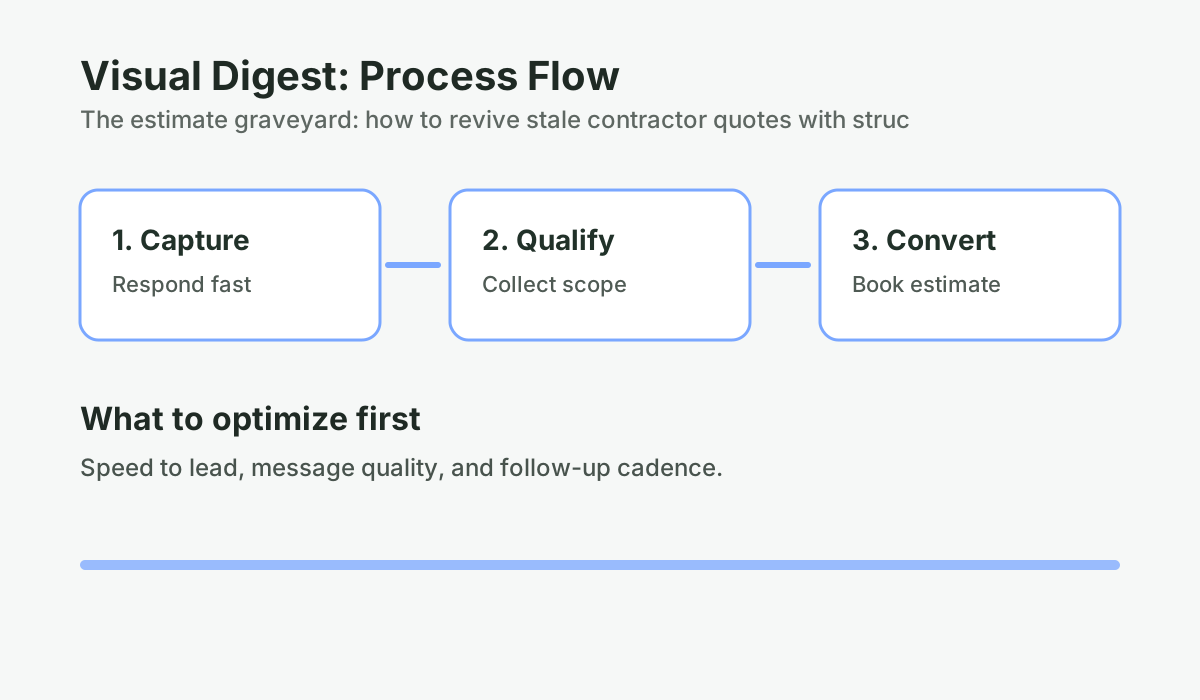
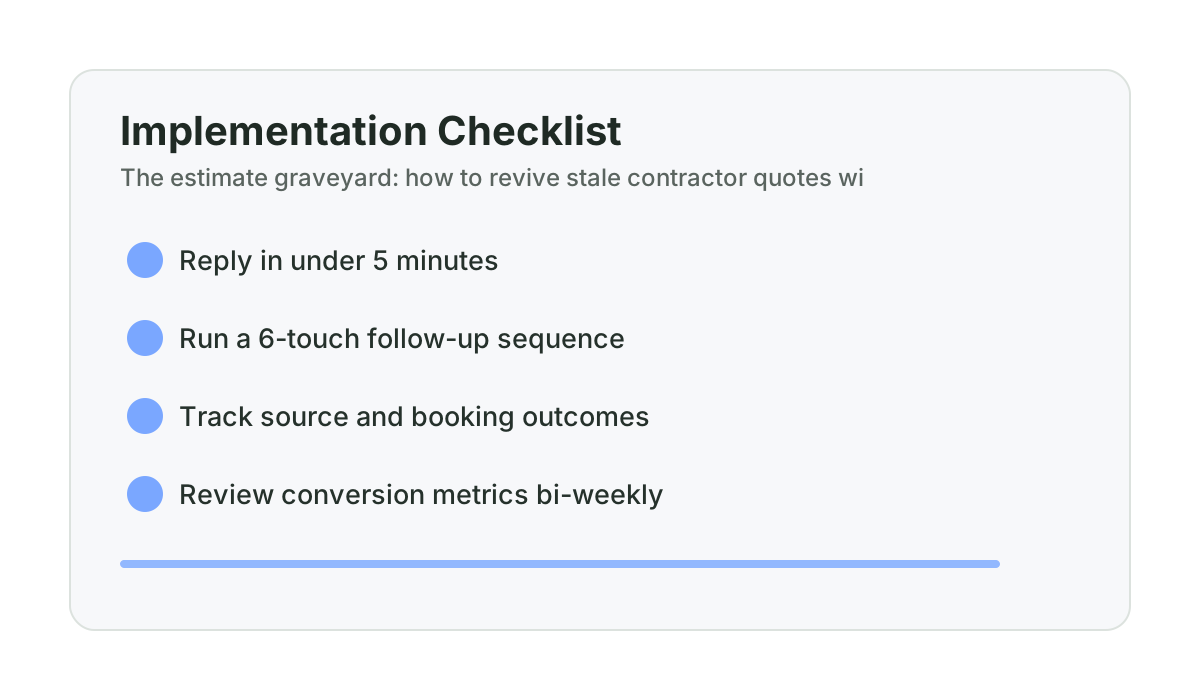
Based on multi-touch conversion research from InsideSales.com and widely cited sales industry follow-up benchmarks, a structured estimate follow-up sequence for renovation contractors should hit six to eight touches across approximately six weeks, with an extended long-cycle nurture for estimates that remain open beyond that window.
Here is a framework that aligns with what the research says about timing, channel preference, and message cadence for high-ticket home services:
| Day | Channel | Message focus | Research rationale |
|---|---|---|---|
| Day 1 | Text | Confirm estimate received, invite questions | Same-day acknowledgment sets expectation of professionalism (InsideSales.com response timing data) |
| Day 3 | Text | Reference a specific detail from their project | Personalization research suggests higher response rates for tailored messages vs. generic outreach (industry follow-up benchmarks) |
| Day 7 | Text | Value-add: relevant insight or question about their timeline | Week-one persistence catches 50%+ of buyers still in active comparison (Salesforce State of Sales) |
| Day 14 | Text | Direct check-in: still planning to move forward? | Two-week mark is the drop-off point where most contractors stop; continuing past it captures the long-cycle buyers |
| Day 21 | Text | Scheduling availability update or seasonal relevance | Creates practical urgency without pressure; aligns with scarcity of contractor availability |
| Day 42 | Text | Long-cycle check-in: if timing has changed, still available | Captures financing-dependent and life-event-delayed buyers at the 4-6 week decision window |
| Day 90+ | Text (monthly) | Seasonal nudges, project inspiration, gentle availability updates | NKBA data shows 15-20% of renovation decisions take 3+ months; monthly presence keeps you in the consideration set |
Sources: InsideSales.com lead response and optimal contact timing research; widely cited sales industry follow-up benchmarks; Salesforce “State of Sales” (5th edition) multi-touch conversion analysis; NKBA renovation consumer decision timeline data.
The key principles across all seven touches:
Text over email for renovation follow-up. Text messages have a 98% open rate compared to 20% for email. Source: Gartner SMS marketing benchmark data; Mobile Marketing Association open rate studies. For contractors whose homeowners are managing busy households, text is the channel that actually gets read.
Personalization is important. Each touch should reference something specific about the homeowner’s project — the scope they discussed, the timeline they mentioned, or the budget range they shared. Generic checking-in messages often perform poorly because they signal that the contractor does not remember the conversation. For examples of what personalized follow-up messages actually sound like without being pushy, the estimate follow-up script guide provides templates for each stage.
Each message should offer something useful. A scheduling update. A relevant insight about material availability. A question that helps the homeowner move forward. The frame is advisory, not sales. You are a contractor who cares about their project, not someone chasing a signature.
The exit ramp matters. Every sequence should include a graceful way for the homeowner to opt out. Not every estimate should convert. But the homeowner who says “we decided to go a different direction” is more valuable than the one who simply disappears — at least you know, and you can respond professionally, which often leads to referrals.
What does the math look like for a typical contractor’s estimate backlog?
Most renovation contractors, when they actually count, have 20 to 60 outstanding estimates at any given time — quotes that were sent in the previous one to six months and did not receive structured follow-up. That backlog represents significant potential revenue that is accessible through systematic outreach.
Here is a scenario model for a contractor with 40 cold estimates and a $50,000 average project value:
| Variable | Conservative estimate | Moderate estimate | Optimistic estimate |
|---|---|---|---|
| Cold estimates in backlog | 40 | 40 | 40 |
| Average estimate value | $50,000 | $50,000 | $50,000 |
| Total pipeline value | $2,000,000 | $2,000,000 | $2,000,000 |
| Re-engagement rate (respond to follow-up) | 10% | 15% | 20% |
| Estimates re-engaged | 4 | 6 | 8 |
| Conversion rate of re-engaged leads | 40% | 50% | 50% |
| Projects recovered | 1.6 | 3 | 4 |
| Recovered revenue (first 90 days) | $80,000 | $150,000 | $200,000 |
Source: Re-engagement and conversion rates modeled from Salesforce State of Sales data on reactivated pipeline leads and NKBA close rate benchmarks for remodeling contractors with structured follow-up. These are modeled projections, not certain outcomes.
Even at the conservative end — recovering 1.6 projects from a 40-estimate backlog — the math is compelling. That is $80,000 in revenue from leads you already invested time estimating. No new marketing spend. No new lead generation. Just following up on work you already did.
The moderate scenario — three recovered projects worth $150,000 — is what the research suggests is realistic for a contractor who implements a consistent six-to-eight touch sequence across their existing backlog. That revenue comes from leads who were not formally lost. They were just waiting for someone to stay in touch. To quantify what your specific pipeline leak looks like, the revenue leak calculator can help you model the numbers for your lead volume and project values.
Why does timing matter more than persuasion for stale estimates?
There is a misconception in sales-oriented thinking that follow-up is about convincing someone to buy. In renovation contracting, the research points to a different mechanism entirely: follow-up is about being present when the buyer’s circumstances align with the purchase.
The Salesforce State of Sales report found that in high-consideration B2C categories, the majority of conversions happen not because the seller became more persuasive, but because the buyer’s situation changed — funding came through, a competing priority resolved, a family member agreed, a season shifted. Source: Salesforce “State of Sales” report (5th edition), multi-touch conversion analysis for high-consideration purchases.
For renovation contractors, this means the purpose of follow-up is not to pressure or convince. It is to maintain presence. You are not trying to change anyone’s mind. You are making sure that when their mind is ready, you are the contractor they think of first.
This is why the tone of every touch in the sequence matters. Aggressive follow-up — “just checking in, are you ready to move forward?” — creates resistance. Advisory follow-up — “I noticed material prices are shifting this quarter; if your timeline is flexible, starting in Q2 could save on countertop costs” — creates value. The homeowner does not feel pursued. They feel informed. And when the timing aligns, they reach out to the contractor who was helpful, not the one who was pushy.
Why do most contractors fail to follow up consistently?
Follow-up depth is the number of structured contact attempts a contractor makes after sending an estimate before marking the lead as inactive. It is the metric with the widest gap between what contractors do (one to two touches) and what the research says is needed (six to eight touches) for high-ticket conversion.
Across renovation contractor conversations, the pattern is consistent: the follow-up problem is persistent. It is not that contractors do not know they should follow up. It is that doing it well manually is genuinely hard.
A manual follow-up system requires: tracking which estimates you have sent, when you sent them, what you discussed, when you last reached out, what the homeowner said, and what the appropriate next step is. At 20 estimates per month, you are managing 40 to 80 outstanding quotes at any given time, each at different stages of the nurture cycle. Maintaining that in a spreadsheet or a notes app while running a business, managing crews, and doing site visits is not sustainable.
What contractors actually do: send one follow-up, maybe two, and then mentally write the lead off. That means they are walking away from a meaningful percentage of their pipeline that just needed more time and more consistent contact. If you want to track this manually before committing to automation, the follow-up pipeline tracking guide shows what to measure and where most contractors lose visibility.
The research on this is clear: most homeowners considering a renovation project require six to eight touchpoints before making a decision. Source: Widely cited sales industry follow-up benchmarks; InsideSales.com (now XANT) optimal contact frequency studies; Salesforce “State of Sales” report on multi-touch conversion. Most contractors provide one or two. The gap between those numbers is where the revenue disappears.
What does automation change about this equation?
The reason structured follow-up works in research studies but fails in practice for most contractors comes down to execution consistency. Knowing you should send six to eight touches is different from actually sending them, on time, with personalization, across 40 to 80 outstanding estimates, while running a renovation business.
Automation solves the execution problem. A system that triggers the right message at the right interval for every outstanding estimate — without requiring the contractor to remember, track, or manually send anything — closes the gap between what the research says works and what actually happens in the field.
The contractor’s role shifts from managing follow-up to responding when a lead re-engages. The system maintains the relationship. The contractor shows up when it matters — for the conversation that converts.
This is not a theoretical distinction. The difference between a contractor who knows they should follow up eight times and one who actually does it eight times, consistently, for every estimate, is the difference between a baseline close rate and a meaningfully higher one. The research supports the improvement. Automation makes it executable.
How should a contractor think about their existing estimate backlog?
If you are reading this and you have 20, 40, or 60 outstanding estimates sitting in a folder with no structured follow-up, here is the practical framework:
Step 1: Count your backlog. Pull every estimate sent in the last six months that did not result in a signed contract. Do not filter by how likely you think the lead is. Count all of them.
Step 2: Calculate the total pipeline value. Multiply the count by your average project value. For most renovation contractors, this number is surprisingly large — often $500,000 to $2,000,000 in potential revenue sitting in an estimate graveyard with no follow-up.
Step 3: Segment by age. Estimates from the last 30 days are warmest. Estimates from 30 to 90 days are still viable — this is where the delayed-decision buyers sit. Estimates older than 90 days need a softer re-engagement approach but are still worth contacting. NKBA data shows 15% to 20% of renovation decisions take three or more months. Source: NKBA consumer purchasing behavior benchmarks for remodeling contractors.
Step 4: Start the sequence. Whether you do it manually or automate it, begin systematic outreach calibrated to where each estimate is in its timeline. Day-one messages for a 90-day-old estimate should acknowledge the time gap: “I quoted your kitchen project back in November — wanted to check in and see if the timing has shifted or if you are still planning to move forward.”
Step 5: Track and measure. Document re-engagement rate (what percentage respond), conversion rate of re-engaged leads, and revenue recovered. These numbers tell you exactly what structured follow-up is worth for your business.
Frequently asked questions
How many follow-up touches does it typically take to convert a renovation estimate?
Widely cited sales industry research consistently shows that six to eight touchpoints are required before a homeowner makes a buying decision on a high-ticket renovation project. Industry follow-up benchmarks suggest that up to 80% of sales in high-consideration categories happen after the fifth contact. Most contractors send one to two follow-ups and then stop, which means they are abandoning the process right before the window where conversion accelerates.
How long should a contractor follow up on a stale estimate?
The practical timeline depends on project type and the homeowner’s signals. For kitchen and bathroom renovations where the average decision cycle is four to twelve weeks, a structured six-week sequence with monthly touches thereafter is a reasonable baseline. Whole-home projects with longer decision cycles can justify nurture sequences extending six to twelve months. NKBA data shows 15% to 20% of renovation decisions take three or more months, so cutting off follow-up at two weeks means losing a meaningful share of eventually-ready buyers.
What should follow-up messages to a cold estimate actually say?
Effective follow-up in home services is neither persistent selling nor passive checking-in. The messages that re-engage cold estimates tend to reference something specific about the homeowner’s project, offer something useful such as a scheduling update or relevant material pricing insight, and make it easy to either reengage or gracefully opt out. Tone should be advisory and low-pressure. The frame is a contractor who remembers their project and genuinely wants to help when the timing is right, not one chasing a signature.
What is a good close rate for renovation contractors?
Industry benchmarks from the NKBA and Remodeling Magazine show renovation contractor close rates generally range from 20% to 30% for contractors without structured follow-up systems. Contractors with consistent multi-touch follow-up sequences typically see close rates in the 30% to 40% range. Measurable close rate improvements from structured follow-up are consistent with Salesforce State of Sales multi-touch conversion patterns and NKBA remodeling industry benchmarks.
Is it worth following up on estimates that are 3 or more months old?
Yes, for renovation work specifically. Unlike emergency repairs where the purchase is time-sensitive, renovation projects are discretionary and schedule-dependent. NKBA data shows 15% to 20% of renovation decisions take three months or longer. A homeowner who went quiet in October may have their financing approved in January. The contractor who is still in touch at that point — even with a simple monthly text — has a meaningful advantage over the three others who stopped following up in November.
Want help applying this to your pipeline?
Use the matching diagnostic tool first, then book a quick strategy call if you want a done-for-you rollout.

Mashrur Rahman
Founder, ConversionSurgery
I build revenue recovery systems for renovation contractors. After seeing how much money remodelers lose to slow follow-up and missed calls, I built a managed service that handles lead response, estimate follow-up, and after-hours capture automatically. The data in these articles comes from running these systems across real contracting businesses.
Related reading
Alberta contractor lead report template: the “without us” line that improves retention
A practical reporting template that makes ongoing system value visible to contractor owners every two weeks.
Calgary vs Edmonton renovation conversion benchmarks: answer rate, speed, and close-rate realities
A practical city comparison to help Alberta contractors set realistic speed and conversion targets by market conditions.
How renovation contractors use Google reviews to win more estimates in Alberta
A review engine for Alberta remodelers: request timing, response templates, and GBP visibility impact on estimate bookings.