What’s a lead worth in renovation? Valuing your pipeline using real project costs
Updated

A kitchen remodeling lead is worth between $8,000 and $12,000 in expected revenue value — before that homeowner has said a word to you. A basement renovation lead is worth $6,000 to $10,000. A bathroom lead, $3,000 to $5,000. These renovation lead value figures come from applying close rate probabilities to average project costs in each trade. Once you know what a lead is actually worth, it becomes much harder to let one sit in your inbox for two days without a response. You’re not ignoring a phone call. You’re leaving a check on the table.
Key takeaways
- Calculate your renovation lead value with one formula: Average Project Value × Close Rate — a $45K kitchen lead at 25% close rate is worth $11,250 in expected revenue.
- Most contractors think in binary (“this lead either closes or doesn’t”) instead of expected value, which causes them to underinvest in response speed and follow-up.
- Your estimate pipeline has a calculable dollar value right now — 15 outstanding $40K kitchen estimates at 25% close rate equals $150,000 in expected revenue.
- The true lifetime value of a renovation lead is roughly 1.8x the first-project value when you factor in referral and repeat probability.
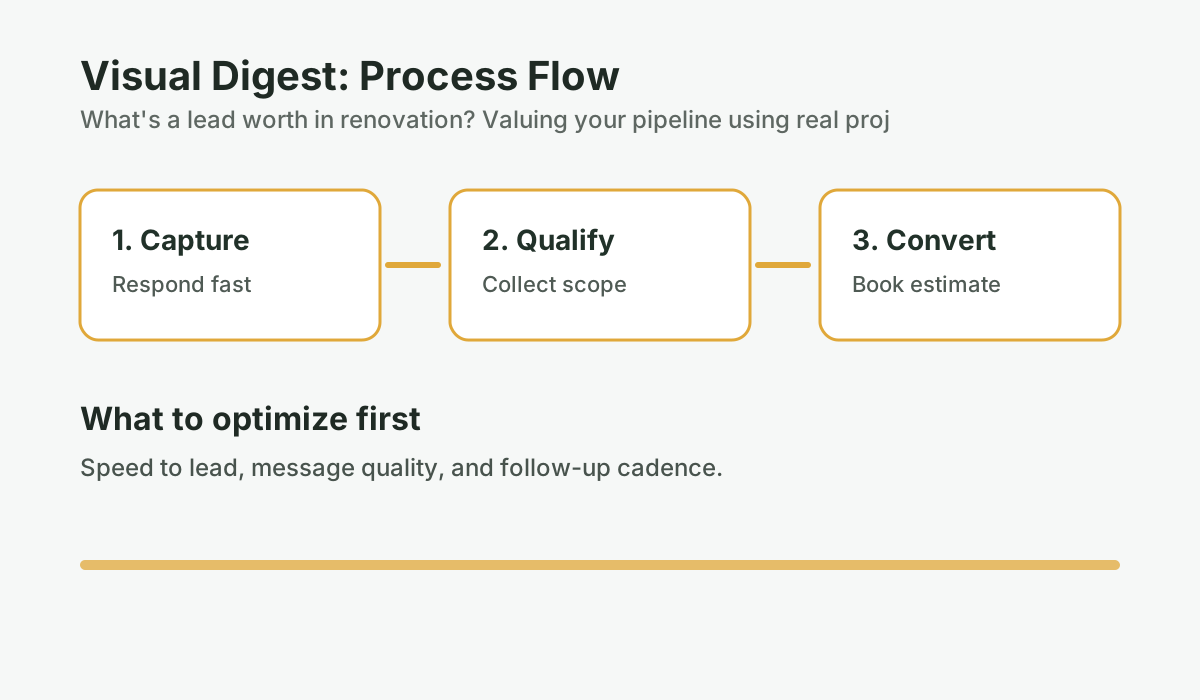
- Scale your follow-up effort to match lead value: a $30K kitchen lead justifies 6–8 follow-up touches, not the one or two most contractors do.
How to calculate renovation lead value for your business
Renovation lead value is the expected revenue a single incoming inquiry represents, calculated by multiplying your average project value by your close rate — it tells you the dollar amount at stake every time a lead goes unanswered.
Lead value is not the same as project value. Lead value is the expected revenue a single inquiry represents — factoring in the probability that it converts to a booked job.
The formula is straightforward:
Lead Value = Average Project Value × Close Rate
If your average kitchen job is $45,000 and you close 25% of qualified leads, each incoming kitchen inquiry is worth $11,250 to you in expected value — today, before you’ve done anything with it.
This changes the psychology of how you handle inquiries. An unanswered call isn’t a nuisance — it’s a $11,250 asset you’ve declined to pick up.
What is the renovation lead value by trade?
Here’s how lead value breaks down across the primary renovation trades, using industry average project costs and close rate ranges from contractor benchmark data.
| Trade | Average Project Value Range | Typical Close Rate | Lead Value Range | Lead Value at 30% Close |
|---|---|---|---|---|
| Kitchen Remodeling | $25,000–$100,000 | 22–35% | $8,000–$12,000 | $10,500 (at $35K avg) |
| Basement Renovation | $30,000–$80,000 | 20–32% | $6,000–$10,000 | $9,000 (at $30K avg) |
| Bathroom Remodeling | $15,000–$50,000 | 22–35% | $3,000–$5,000 | $5,250 (at $17.5K avg) |
| Whole-Home Renovation | $100,000–$500,000+ | 15–25% | $20,000–$50,000+ | $37,500 (at $150K avg) |
| Home Addition | $50,000–$200,000 | 18–28% | $12,000–$25,000 | $18,750 (at $75K avg) |
Source: Remodeling Magazine Cost vs. Value Report 2023–2024; ServiceTitan Contractor Benchmark Report 2022; NARI (National Association of the Remodeling Industry) industry data
Why most contractors have an inaccurate sense of lead value
The typical contractor mental model for lead value is binary: this lead either becomes a job or it doesn’t. They think about individual leads in isolation — “that one didn’t pan out” — rather than thinking about the expected value of a lead type over time.
This creates a systematic undervaluation of inbound inquiries. A kitchen remodeler who closes 25% of leads doesn’t consciously think “this call is worth $11,250.” They think “there’s a 75% chance this call goes nowhere.” That framing makes it easier to rationalize not calling back for six hours, or sending a generic form email, or forgetting to follow up after the estimate.
The shift to expected value thinking changes the behavior. If you know every kitchen inquiry is worth $11,250 in expected revenue, you respond to all of them promptly — because even the ones that don’t close are contributing to your actual average. The ones that don’t close are simply the natural 75% that the math already accounts for. You don’t get discouraged by them. You just respond to the next one.
How does lead value set your follow-up investment ceiling?
Here’s why lead value matters beyond psychology: it sets a rational ceiling for what you should spend to convert or recover a lead.
If a kitchen lead is worth $10,000 in expected revenue, and you could spend $500 in follow-up effort — automated messages, time on the phone, a second estimate visit — to close even half the leads you’d otherwise lose, the economics are strongly in favor of spending the $500. If you don’t yet have a structured follow-up process, these estimate follow-up scripts show you how to stay persistent without sounding salesy.
The same logic applies to a managed follow-up system. If a system costs $997/month and you’re receiving 20 kitchen leads per month at $10,000 each, your total monthly lead value is $200,000. The system costs 0.5% of that monthly lead value. If it improves your close rate from 25% to 30% — a five-point gain — it adds $10,000 per month in revenue on 20 leads at $10,000 each. That’s roughly a 10x monthly return on the system cost.
What would fixing your follow-up gaps actually be worth?
Three inputs from your business. One formula. A clear picture of the revenue you could recover this year.
Run the numbers for your business: Run the Revenue Leak Scorecard. It takes 2-3 minutes and gives you a clear baseline before your next estimate round.
Pipeline valuation: what your outstanding estimates are actually worth
Pipeline valuation is the total expected revenue from all your currently outstanding estimates — calculated by multiplying the number of open estimates by average project value and your expected close rate on followed-up quotes.
Lead value thinking doesn’t stop at the incoming inquiry. It extends to your estimate pipeline — the jobs you’ve quoted but haven’t heard back on.
Here’s how to value your current estimate pipeline:
Pipeline Value = (Number of Outstanding Estimates × Average Project Value) × Expected Close Rate from Follow-Up
Say you have 15 outstanding kitchen estimates averaging $40,000 each. That’s $600,000 in gross pipeline. At a baseline 25% close rate on estimates you’ve already sent, that’s $150,000 in expected revenue from your current pipeline — assuming you follow up consistently.
But research on estimate follow-up is clear: contractors who follow up six to eight times over six weeks close significantly more estimates than those who follow up once or twice. The difference between consistent follow-up and occasional follow-up on an already-sent estimate can produce meaningfully higher close rates. Source: Velocify Lead Management Best Practices; widely cited sales industry research on follow-up contact frequency If your pipeline is full of quotes you’ve sent but not followed up on, tracking your follow-up pipeline is the first step to stop leaving that money on the table.
On 15 outstanding estimates worth $40,000 average, moving from 25% to 35% close rate through better follow-up adds $60,000 in recovered revenue from jobs you’d already done the work of estimating.
The lifetime value multiplier
Every lead value calculation in this post so far measures first-project revenue only. The real number is higher because renovation clients refer and return.
The National Association of the Remodeling Industry found that renovation contractors get 55–65% of new business from referrals from past clients. Source: NARI Remodeling Industry Report, 2022 Roughly 15–25% of past clients engage the same contractor for a subsequent project within three years.
This means the true value of a kitchen lead isn’t just the $10,000 in expected first-project revenue. It’s that plus the referral probability (say, 60% × $10,000 for one referral = $6,000 additional expected value) plus the repeat probability (20% × $10,000 = $2,000 additional expected value). Total expected value: approximately $18,000 per kitchen lead over a three-year horizon.
This does not mean you should operate on those long-tail numbers for day-to-day decisions. But it’s worth understanding that the cost of a permanently lost lead isn’t just the first project — it’s that project’s entire referral and repeat chain.
What should you do with your renovation lead value number?
Knowing your lead value should change three specific behaviors:
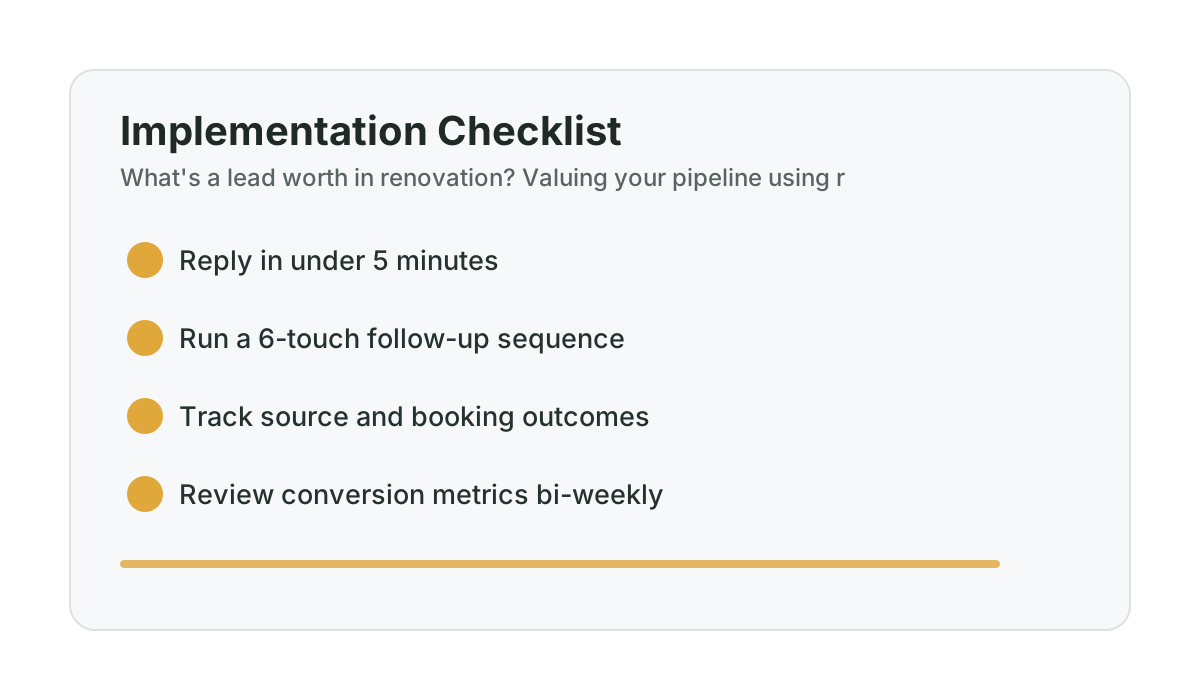
1. Set a maximum acceptable response time. If a kitchen lead is worth $10,000 in expected revenue, you have a clear budget for how much time, money, and system cost is justified to respond faster. A system that costs $997/month and ensures every lead gets a response within seconds during legally permitted messaging hours, with restricted-hour inquiries queued for the next compliant window, can pay for itself if it recovers even one additional kitchen job per month. If your biggest gap is after-hours inquiries going unanswered, an after-hours intake form that books estimates can capture leads that would otherwise wait until morning.
2. Invest in estimate follow-up proportional to project value. A $3,000 bathroom lead justifies three or four follow-up touches. A $30,000 kitchen lead justifies six to eight. Your follow-up cadence should scale with the expected value of the job.
3. Track lead value by source to allocate marketing spend correctly. If your Google Ads leads have a lower close rate than your referral leads, their lead value is lower. You may be over-investing in ad spend and under-investing in referral systems. Lead value by source is one of the most useful numbers a contractor can track — and almost none of them do.
A kitchen remodeler who implemented systematic lead valuation and follow-up tracking with the structured follow-up systems report measurable close rate improvements — adding significant annual revenue from the same number of inquiries. Many leads were already there. The value was already there. The system just makes capturing it consistent instead of accidental.
Frequently asked questions
What is the average renovation lead value for a kitchen remodeling contractor?
A kitchen remodeling lead is worth approximately $8,000 to $12,000 in expected revenue value, calculated by multiplying the average project value ($35,000–$50,000 range) by a typical close rate of 22–35%. At a 25% close rate and $40,000 average project, each incoming kitchen inquiry is worth $10,000 in expected revenue. This number increases with better follow-up systems that improve close rates.
How do I calculate what a lead is worth in my renovation business?
The formula is: Lead Value = Average Project Value × Close Rate. Take your total revenue from the last 12 months, divide by the number of completed jobs to get your average project value. Then divide jobs won by estimates sent to get your close rate. Multiply those two numbers. That’s the expected revenue value of each incoming qualified inquiry you receive.
How does lead value differ between basement, kitchen, and bathroom remodeling?
Kitchen leads typically have the highest expected value ($8,000–$12,000) due to higher average project costs. Basement renovation leads run $6,000–$10,000, and bathroom leads $3,000–$5,000. Whole-home renovation leads can be worth $20,000–$50,000+ depending on project scope. The difference is driven by average project size, not close rate — close rates are fairly consistent across trades at 20–35% for most renovation contractors.
Should I value referral leads differently than Google Ads leads?
Yes. Referral leads typically have higher close rates (35–50%) than ad leads (20–30%) because the homeowner has a pre-existing trust relationship with the contractor through whoever referred them. A kitchen referral at 45% close rate and $40,000 average project is worth $18,000 — nearly double the $10,000 expected value of a cold ad lead at 25% close. Tracking lead value by source helps you allocate marketing investment correctly.
What’s the lifetime value of a renovation client versus single-project lead value?
Single-project lead value only captures the first job. Lifetime value adds referral and repeat probability. If 60% of clients refer one additional client and 20% return for a second project, and your lead value is $10,000, your true lifetime customer value is approximately $18,000 per acquired client over three years. This means permanently losing a lead doesn’t just cost you one project — it costs you a compounding revenue chain.
Want help applying this to your pipeline?
Use the matching diagnostic tool first, then book a quick strategy call if you want a done-for-you rollout.

Mashrur Rahman
Founder, ConversionSurgery
I build revenue recovery systems for renovation contractors. After seeing how much money remodelers lose to slow follow-up and missed calls, I built a managed service that handles lead response, estimate follow-up, and after-hours capture automatically. The data in these articles comes from running these systems across real contracting businesses.
Related reading

Deposit and invoice reminder system for contractors: improve cash flow without awkward chasing
A practical automation framework for deposit and invoice reminders that improves payment speed and reduces owner stress.

The $997 vs hiring debate: cost comparison for lead coverage and follow-up
An office admin costs $50K+/year. A VA runs $2K–$3K/month. An answering service $250–$500/month. Honest cost comparison for every option.

Marketing ROI without guesswork: from lead to booked estimate to closed job
Most contractors track spend and jobs won. Inquiry to estimate to close is where visibility disappears and money leaks. Here’s what to measure.