Calgary renovation lead response benchmarks (2026): basement, kitchen, and bathroom contractors
Updated
Most Calgary renovation contractors know they are busy. Fewer know whether they are fast enough. In a market where homeowners request 3-5 quotes in one evening, speed is not a nice-to-have KPI. It is pipeline control. If your average first response is even 20 minutes slower than local competitors, you are donating qualified leads to them.
Key takeaways
- In Calgary, response speed under 5 minutes materially outperforms anything above 15 minutes for booked estimate rates.
- A practical local benchmark is 85%+ answer rate across calls, forms, and SMS.
- Basement and kitchen projects have the highest penalty for delayed follow-up because decision windows are competitive and high-ticket.
- If your median response time is above 15 minutes, fixing speed-to-lead is usually your fastest path to revenue lift.
What are realistic lead response benchmarks for Calgary contractors?
Calgary lead response benchmarks are reference ranges for first-response time, answer rate, and booked estimate rate that indicate whether a renovation contractor is underperforming, average, or competitive in the local market.
| Metric | Needs work | Competitive | Top-tier |
|---|---|---|---|
| First response time | 15+ minutes | 3-10 minutes | Under 2 minutes |
| Answer rate (all channels) | Below 65% | 65-85% | 85%+ |
| Inquiry to booked estimate | Below 25% | 25-45% | 45%+ |
These ranges are directional operating benchmarks, not guaranteed outcomes. Calibrate them against your own CRM and call tracking data. Source context: Harvard Business Review summary of MIT lead response research
Where Calgary contractors lose speed in real life
The pattern is predictable: homeowner submits a form at 8:41 PM, gets no acknowledgement, calls two competitors, and by morning one estimate is already booked. Your team may still call back next day, but by then you are the backup option.
For deeper context on why this happens so consistently, see the 42-minute problem breakdown and the weekend inquiry playbook.
How fast are you actually responding to leads?
Take the Speed-to-Lead Leak Scorecard. Five questions, three minutes. See where you stand compared to contractors who close 35%+ of their estimates.
Run the numbers for your business: Take the Speed-to-Lead Scorecard. It takes 2-3 minutes and gives you a clear baseline before your next estimate round.
Trade-level differences: basement vs kitchen vs bathroom
| Project type | Typical ticket | Delay sensitivity | Why |
|---|---|---|---|
| Basement renovation | $35K-$85K | High | Homeowners compare multiple bids quickly and shortlist early. |
| Kitchen remodel | $30K-$100K | Very high | Long decision cycle, but first responder controls early trust. |
| Bathroom remodel | $15K-$50K | Medium-high | Higher quote volume per homeowner means faster vendor switching. |
What to fix first if you are below benchmark
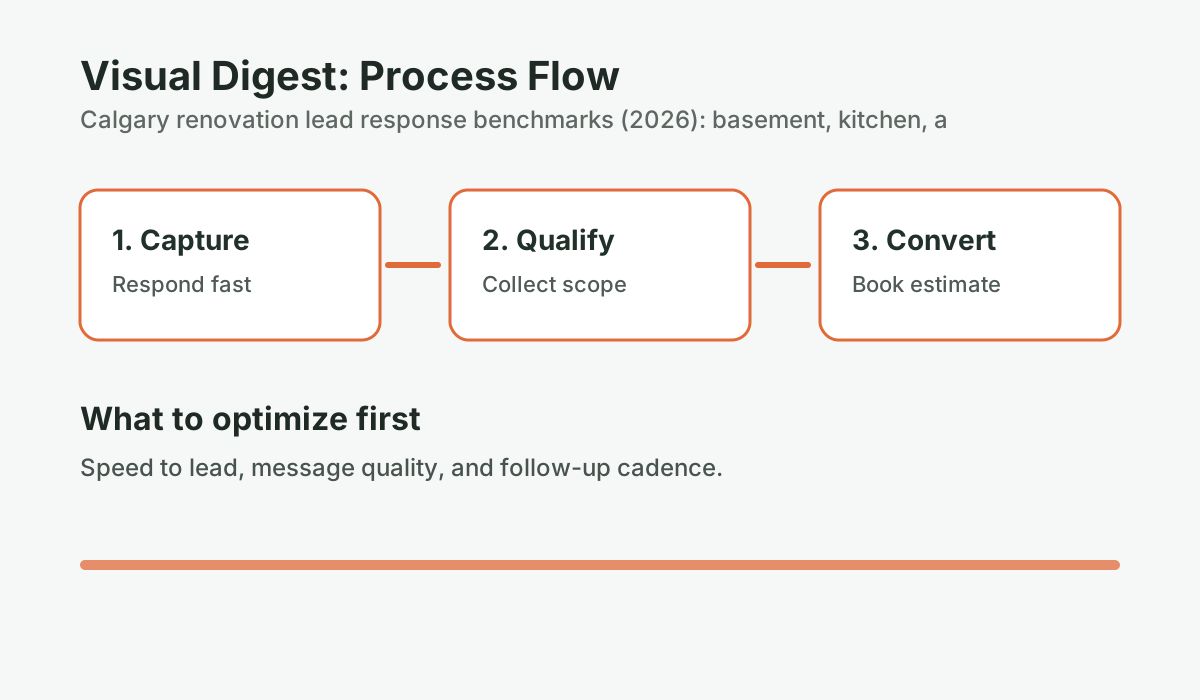
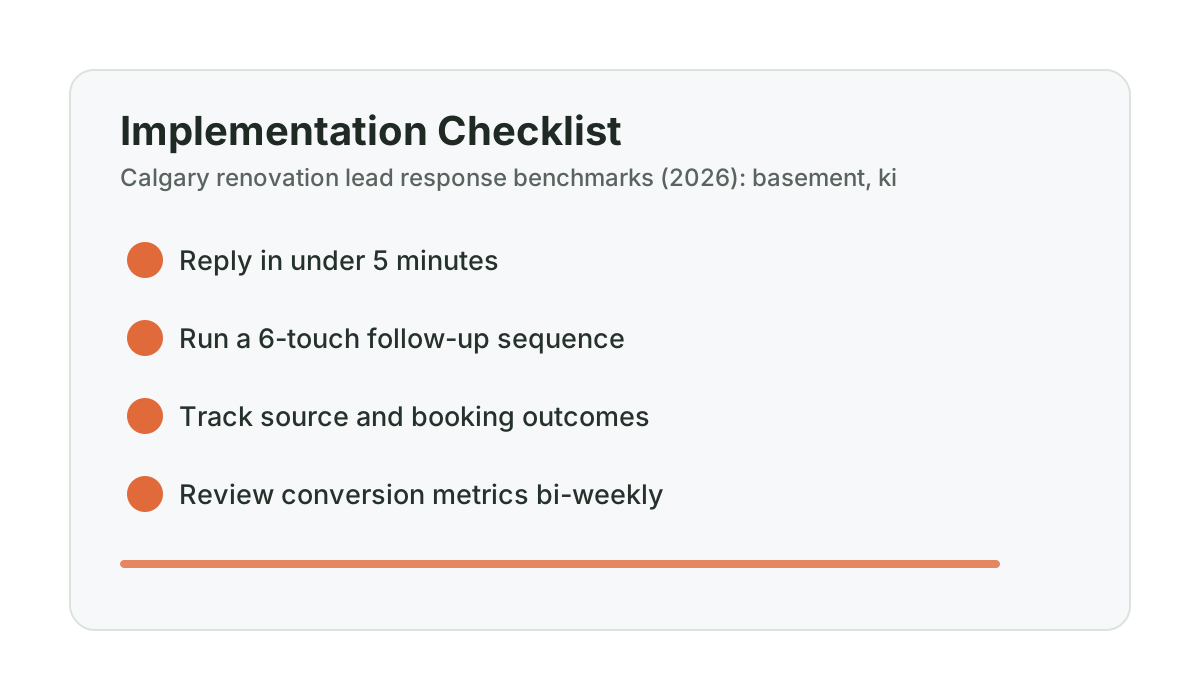
- Implement missed-call text-back within 60 seconds.
- Add after-hours form auto-replies with a real qualifying question.
- Track median first-response time weekly, not monthly.
- Run a 7-day speed challenge and compare booked estimate rate before/after.
If speed is solved but close rates still lag, your next leak is usually estimate follow-up. Start with a structured follow-up cadence.
How to operationalize this in your first 30 days
Most contractors understand the strategy but get stuck in execution. The highest-performing operators in Calgary, Edmonton, Red Deer, and Lethbridge run this like a weekly operating rhythm, not a one-time marketing project. The pattern is consistent: define one measurable target, implement one workflow change at a time, and review pipeline movement every two weeks. This reduces noise and lets you see what actually moved booked estimates, response rate, and close probability.
| Week | Execution focus | Expected impact | Proof signal to watch |
|---|---|---|---|
| Week 1 | Baseline metrics + routing checks | Stops hidden lead leakage | All channels logging correctly in one view |
| Week 2 | Script + sequence activation | Higher response and conversation rates | First-response and reply rate lift |
| Week 3 | Objection handling + escalation logic | More qualified conversations progress | Booking rate and reactivation movement |
| Week 4 | Bi-weekly performance review | Sustainable optimization loop | Directionally stronger pipeline value |
This is where most teams fail: they implement tools but skip operating cadence. If you want a stronger foundational model before expanding scope, review this related guide, then use the supporting benchmark framework, and finally connect it to the tactical execution layer.
What to measure so this becomes revenue, not activity
A reliable contractor growth loop tracks leading indicators (response speed, engagement, bookings) and lagging indicators (signed revenue, payment speed, retained pipeline) in one bi-weekly view so operators can tie actions to outcomes.
For SEO/AEO performance, this section answers the practical question owners actually ask: “How do I know this is working fast enough to justify continued focus?” The answer is not one vanity metric. Use a 6-metric view so you can diagnose where conversion breaks.
| KPI | Why it matters | Target direction |
|---|---|---|
| Median first response time | Earliest predictor of lead win probability | Down |
| Conversation start rate | Shows whether speed + message quality are working | Up |
| Inquiry-to-booking rate | Main conversion midpoint KPI | Up |
| Estimate follow-up response rate | Measures nurture effectiveness over real sales cycles | Up |
| Attributed signed opportunities | Ties operations to revenue impact | Up |
| Without-system risk range | Makes cancellation cost concrete | Visible + improving |
Alberta execution notes that change outcomes
Alberta markets are not uniform. Calgary and Edmonton demand tighter response windows due to contractor density in key neighborhoods. Red Deer and Lethbridge usually reward consistency and follow-up depth over pure speed alone. In winter planning months, indoor renovation categories like basements, kitchens, and bathrooms tend to benefit disproportionately from structured nurture because decision cycles stretch and homeowners revisit options multiple times before signing.
That means local relevance is not just GEO copy. It is operational behavior adapted by market: speed-first where competition is dense, persistence-first where consideration windows are longer, and proof-first where homeowners are comparing trust signals such as review recency and communication professionalism.
Failure modes and fast corrections
- Failure mode: team assumes workflow is active but routing silently fails in one channel. Fix: run a weekly mystery-lead test across call, form, and SMS.
- Failure mode: responses are fast but generic, so conversation quality remains weak. Fix: use one contextual qualifier in first response and one clear next step.
- Failure mode: follow-up exists but no owner can interpret results. Fix: enforce bi-weekly scoreboard with low/base/high assumptions and explicit notes.
- Failure mode: activity rises but no one marks wins/losses, so attribution collapses. Fix: make stage updates a required end-of-day ritual.
When this is run correctly, the business experiences both revenue and lifestyle gains: fewer dropped inquiries, stronger estimate continuity, reduced owner mental load, and more predictable pipeline visibility. That is the point of this system: less guesswork, faster decisions, and measurable conversion movement over 30-90 day windows.
Frequently asked questions
What is a good response time for Calgary contractors in 2026?
Under 5 minutes is a competitive target. Under 2 minutes is top-tier, especially for evening and weekend inquiries.
Do local benchmarks matter more than global averages?
Yes. Homeowners compare you against nearby competitors, not national medians. Local speed standards determine real win rates.
What metric should I watch first?
Median first-response time. It is the fastest diagnostic for whether your lead handling system is competitive.
How often should I benchmark?
Bi-weekly for response time and answer rate, monthly for booked estimate and close-rate trend analysis.
Can I improve this without hiring staff?
Yes. Most contractors fix this with automation + managed follow-up rather than adding office headcount first.
Want help applying this to your pipeline?
Use the matching diagnostic tool first, then book a quick strategy call if you want a done-for-you rollout.

Mashrur Rahman
Founder, ConversionSurgery
I build revenue recovery systems for renovation contractors. After seeing how much money remodelers lose to slow follow-up and missed calls, I built a managed service that handles lead response, estimate follow-up, and after-hours capture automatically. The data in these articles comes from running these systems across real contracting businesses.
Related reading
First-response scripts for Alberta renovation contractors: what to send in the first 60 seconds
A practical 60-second response script library for missed calls, web forms, and inbound SMS in Alberta renovation markets.
The 7-day speed-to-lead challenge for renovation contractors
Track your actual lead response time for 7 days and you’ll see exactly where you’re losing jobs. Most contractors are surprised by what they find. Here’s the framework.
How to build a speed-to-lead SOP when you’re on the job site
A speed-to-lead SOP for contractors defines exactly what happens to every new lead — while you’re on a ladder, in a meeting, or offline after hours. Here’s how to build one.